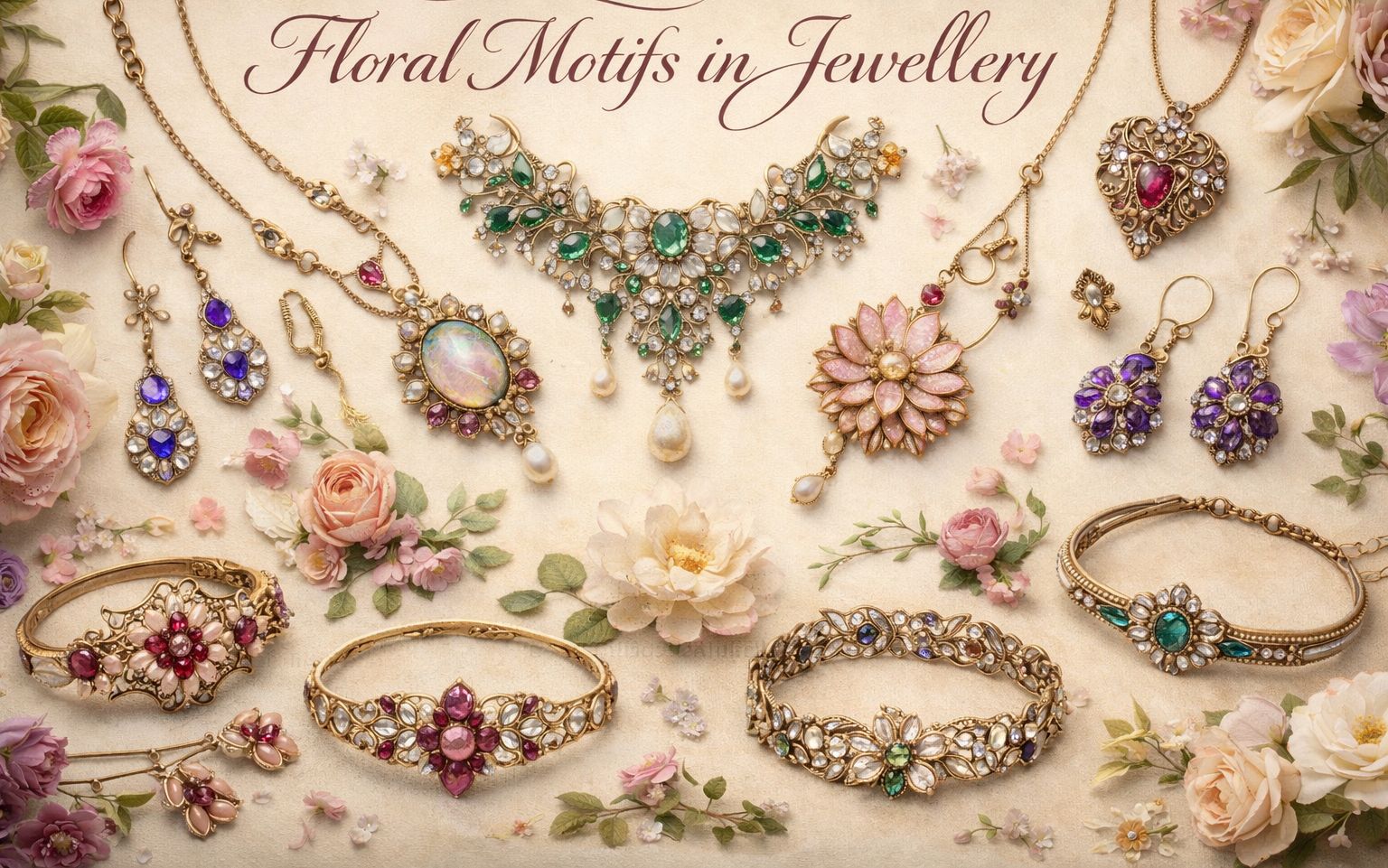
The Eternal Bloom: Floral Motifs in Antique Jewellery
From roses for love to white lilies for purity or sunflowers for adoration, flowers have always had a secret language hidden in them. When embedded in vintage and antique jewellery, these floral motifs become something more permanent and infinitely more beautiful.
Romantic, symbolic, and endlessly varied, antique floral jewellery captures the language of flowers in precious metal and stone.
So, why do floral motifs in jewellery possess such a unique charm and attraction? This is because flowers may fade in a vase, but flowers in jewellery bloom eternally. There is magic in capturing nature’s ephemeral creations and transforming them into something permanent.
This guide will take you on a journey through the world of floral motifs in antique and vintage jewellery, and their symbolism.
The Language of Flowers
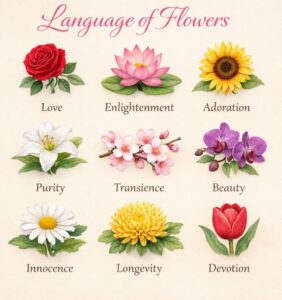
The language of flowers, or floriography, is a Victorian-era method of cryptic communication where flowers, plants, and specific floral arrangements were used to send coded messages.
While the use of flowers as a secret language became more popular in the Victorian era, the use of floral motifs in jewellery spans millennia.
Here’s a guide on the meaning behind all popular flowers.
History of Floral Motifs in Jewellery
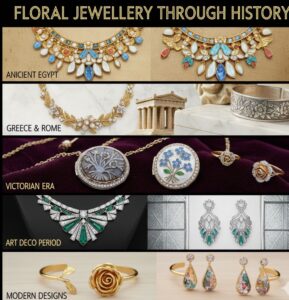
Even though floral motifs in jewellery were popular in ancient civilisations, it was from the late 18th century onwards that floral motifs flourished with remarkable creativity, technical refinement, and emotional depth. Let’s trace this fascinating journey—era by era—through time.
Ancient Beginnings
In ancient Egypt, for instance, the lotus flower symbolised rebirth and regeneration, frequently appearing in jewellery as an emblem of the afterlife. In ancient Greece and Rome, flowers were closely linked to mythology and divine narratives. Roses were associated with Aphrodite and Venus, goddesses of love and beauty, making them symbols of passion and desire. Lilies, on the other hand, were connected to Hera and Juno, representing purity, fertility, and divine femininity.
The Middle Ages & Renaissance
As Europe entered the Middle Ages, jewellery became a visual language of faith and morality. Floral motifs were no longer merely decorative—they were symbolic.
The lily, especially the white lily, became synonymous with purity, humility, and the Virgin Mary. Roses represented divine love and martyrdom.
Georgian Era
The Georgian period marked a turning point in the emotional use of floral motifs. Jewellery became deeply personal, often commissioned to commemorate love, loss, or remembrance.
- Floral motifs were especially prominent in mourning jewellery:
- Forget-me-nots symbolised remembrance and enduring affection
- Lilies-of-the-valley represented purity and reunion in the afterlife
Victorian Age
The Victorian era, deeply influenced by Romanticism, elevated floral jewellery to new heights of popularity.
Jewellery designs ranged from sentimental lockets and brooches to elaborate necklaces and tiaras. Edwardian Period
The Edwardian era introduced a lighter, more ethereal approach to floral jewellery. The widespread use of platinum revolutionised design, allowing for fine, lace-like constructions that were both strong and delicate.
Art Nouveau
The Art Nouveau movement embraced nature in its most expressive and imaginative form. Rejecting rigid symmetry, jewellers created sweeping, asymmetrical designs inspired by flowers, plants, and the female form.
Art Deco Era
With the arrival of the Art Deco period, jewellery design shifted towards bold geometry and modernity. Floral forms became symmetrical and angular, and designs balanced nature with structure.
Related Reads:
Popular Floral Motifs in Antique Jewellery
Flowers have always spoken a language beyond words. When translated into jewellery, flowers become eternal—preserved in gold, silver, enamel, and gemstones.
- 🌹 Roses: Love, Passion, and Devotion
Most Common Jewellery Types:
- Brooches
- Lockets
- Rings
- Pendant necklaces
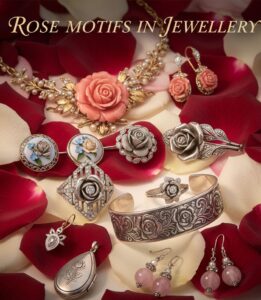
Roses symbolised love in all its forms—romantic, divine, and enduring. Rose motifs were especially popular in Victorian jewellery, often used in sentimental pieces exchanged between lovers or spouses.
- 🌸 Forget-Me-Nots: Memory and Remembrance
Most Common Jewellery Types:
- Mourning rings
- Enamelled brooches
- Bracelets
Forget-me-nots symbolised remembrance, loyalty, and enduring affection, particularly after death or separation.
Highly sought after in Georgian and early Victorian mourning jewellery, these motifs often appear in delicate blue enamel with pearls or seed diamonds.
- 🌼 Lilies: Purity and Renewal
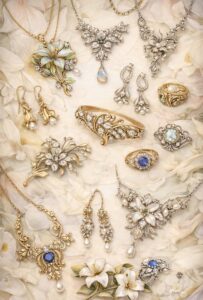
Most Common Jewellery Types:
- Brooches
- Pendant necklaces
- Earrings
Lilies represented purity, humility, and spiritual renewal. Popular across Georgian, Victorian, and Edwardian jewellery, lily motifs were often worn for weddings and formal occasions.
- 🌺 Lotus: Rebirth and Eternity
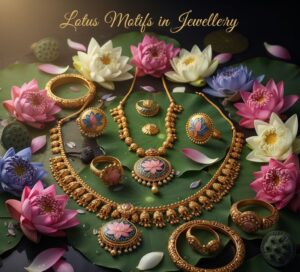
Most Common Jewellery Types:
- Amulets
- Bead necklaces
- Gold pendants
- Temple jewellery
The lotus symbolised rebirth, regeneration, and eternal life, particularly in ancient Egyptian and later Eastern traditions.
Lotus motifs appear in ancient and temple jewellery, often crafted in gold.
- 🌷 Violets: Loyalty and Modesty
Most Common Jewellery Types:
- Rings
- Sweetheart brooches
- Small pendants
Violets conveyed faithfulness, humility, and quiet devotion. Frequently used in Victorian romantic jewellery, violet motifs were subtle and intimate.
- 🌿 Ivy: Fidelity and Eternal Bond
Most Common Jewellery Types:
- Wedding rings
- Bracelets
- Brooches
Ivy symbolised eternal attachment, fidelity, and unbreakable bonds. Ivy motifs are commonly found in Victorian wedding jewellery and sentimental pieces.
- 🌼 Daisies: Innocence and Youth
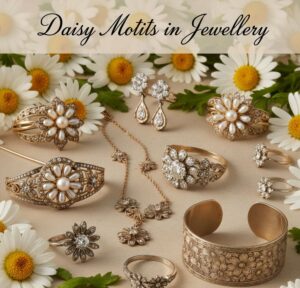
Most Common Jewellery Types:
- Brooches
- Rings
- Necklaces
Daisies represented innocence, purity, and childhood joy.
Queen Victoria’s fondness for daisies helped popularise them. Daisy-set jewellery from the Victorian era is cheerful, wearable, and highly recognisable.
- 🌺 Irises & Orchids: Faith, Wisdom, and Exotic Beauty
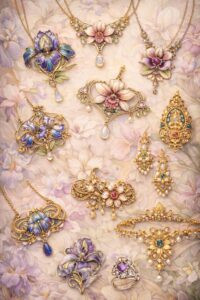
Most Common Jewellery Types:
- Enamelled brooches
- Pendants
- Art Nouveau necklaces
Irises symbolised faith and wisdom, while orchids represented rare beauty and refinement.
These motifs dominate Art Nouveau jewellery, where flowing forms, enamel, and coloured gemstones brought flowers to life in dramatic, artistic ways.
Why Floral Motifs Work So Well Across Jewellery Forms
Flowers adapt effortlessly to jewellery design because:
- Natural Symmetry and Organic Repetition
Flowers offer a balance that feels effortless rather than forced. At the same time, flowers allow for gentle variation. No two petals need to be identical, making floral motifs ideal for jewellery types that rely on repetition, such as necklaces and bracelets.
- Scalable Beauty: From Whisper to Statement
Few motifs adapt to scale as gracefully as flowers. A single diamond-set forget-me-not can be rendered small enough for a ring or earring, while the same motif can expand into a full-blown floral spray for a brooch or necklace without losing its identity.
- Emotional and Aesthetic Resonance
Beyond form, flowers carry meaning that is immediately understood. Love, remembrance, purity, renewal—these ideas require no explanation when expressed through floral imagery.
The Allure of Floral Magic in Jewellery
Floral motifs in jewellery possess an enduring emotional power that transcends time, culture, and fashion. From ancient civilisations to the modern era, flowers have been used not merely as ornamentation but as carriers of meaning—each bloom chosen to express sentiment, memory, or identity.
Today, floral motif jewellery continues to hold its allure not only for its beauty, but for its ability to connect the past with the present. There is, perhaps, room once again for a romantic renaissance—one that recognises flowers not simply as decorative forms, but as timeless emblems of human emotion and aesthetic harmony.
Giftex – A World of Collectibles Auction
Giftex is proud to present its much-anticipated A World of Collectibles Auction this February. Showcasing an exceptional selection of antique and vintage collectibles, the auction places a special emphasis on fine jewellery—from elegant bracelets and necklaces to timeless earrings. Thoughtfully curated and rich in character, the collection offers collectors and connoisseurs the opportunity to discover truly distinctive treasures.


About Post Author