The Beauty of Less: Indian Minimalism in Contemporary Art
In response to the excesses of Abstract Expressionism and the intensely emotive and expressive painting that typified that movement, minimalism emerged as a distinct art trend in the 1960s. While the Western world embraced a stripped-down, “what you see is what you see” philosophy, a parallel yet deeply different evolution was taking place in India.
In a world overflowing with visuals, messages, and endless distractions, the quiet power of minimalist painting stands out like a breath of fresh air. Minimalism reminds us that simplicity can be deeply expressive, and that beauty often lies in restraint rather than excess. The minimalist art movement emphasises simplicity by eliminating unnecessary details. However, in India, this simplicity has rarely been empty. Instead, it has been layered with meaning, spirituality, and cultural memory.
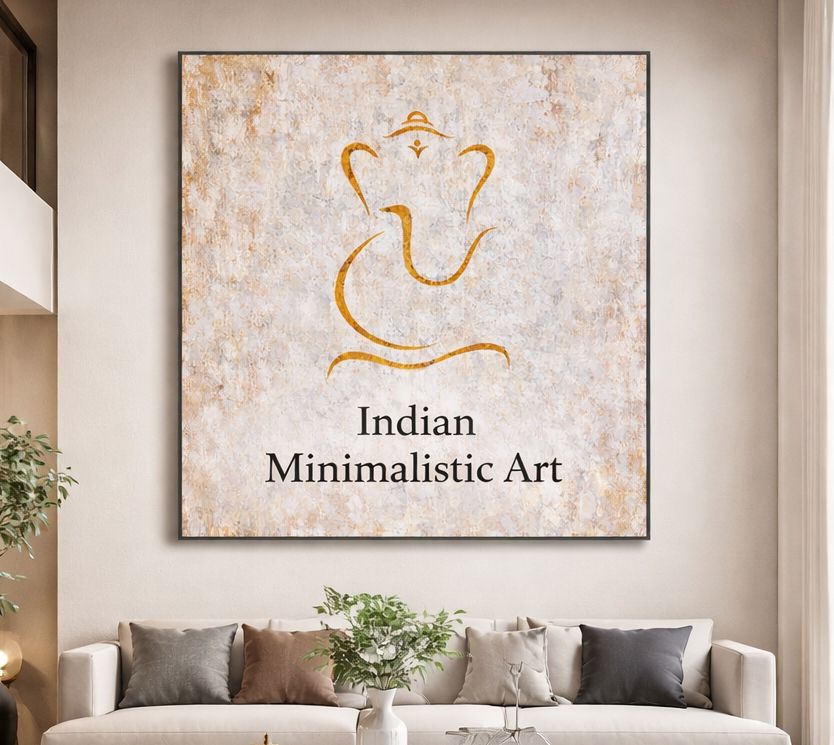
Unlike Western minimalism’s direct and often industrial approach, Indian minimalism is rooted in spiritual, traditional, and sustainable philosophies. Reduced forms are blended with cultural narratives, creating a unique visual language. So, what is Indian minimalism? How did it develop, and who are the artists who shaped it? These questions are explored in depth below.
Also Read: Expressionism In Indian Modern Art
What is Indian Minimalism?
Indian minimalism is not a singular, tightly defined art movement. Rather, it has been understood as a sustained aesthetic approach that evolved through post-independence Indian modernism. It has been deeply rooted in Indian philosophical and cultural traditions, and it has often been described as a pursuit of the “maximum of the minimum.”
Instead of rejecting meaning, as seen in some Western minimalist practices, Indian minimalism has often embraced it. Minimalism in art embraces simplicity, not as an end, but as a means to convey deeper truths.
Historical Evolution: When Did Minimalism Start in India?
Although minimalism as a global movement emerged in the 1960s, its foundations in India can be traced much earlier.
Ancient and medieval Indian art had already demonstrated a tendency toward reduction and abstraction. Buddhist mandalas, Jain diagrams, and temple floor patterns had simplified complex cosmological ideas into geometric forms. Tribal art traditions, such as Warli, had long relied on basic shapes to narrate everyday life.
However, the modern articulation of Indian minimalism began to take shape in the early 20th century. Artists like Jamini Roy rejected Western academic realism and turned toward indigenous traditions.
During the 1950s to 1970s, abstraction gained prominence. It was during this period that artists such as V.S. Gaitonde and S.H. Raza began exploring reductionist forms, eventually shaping what is now recognized as Indian minimalism.
Key Concepts and Influences
-
Philosophical Roots
Indian minimalism has often been shaped by Hindu, Buddhist, and Jain philosophies. Concepts such as emptiness, cosmic order, and the infinite have been explored through minimal forms.
-
Gandhian Frugality
The philosophy of Mahatma Gandhi has played a subtle yet powerful role. His emphasis on simple living, minimal consumption, and honesty in materials has resonated deeply with minimalist ideals.
-
Spiritual Abstraction
Unlike Western minimalism, which can feel detached, Indian minimalism has often been inward-looking. Paintings and sculptures have been created as meditative spaces rather than decorative objects.
-
Functional and Environmental Awareness
Minimalism in India has frequently carried a message. Environmental concerns, sustainability, and the use of local materials have been integrated into artistic practices.
-
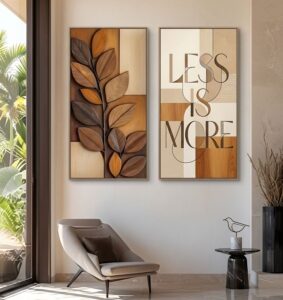
“Less is More”
When emphasising “Less is More” philosophy, reduction has been central, but it has rarely been empty. Each element that remains has been intentional and symbolic.
Key Characteristics of Indian Minimalist Art
-
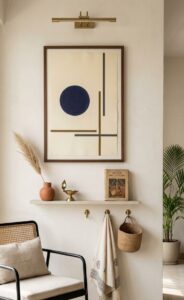
Simplicity of Form
Basic shapes such as circles, squares, and lines have been used to construct compositions. Complexity has been reduced without losing depth.
-
Limited Colour Palette
Muted tones, earthy shades, and restrained colour schemes have often been preferred. In some cases, a single colour has dominated the entire canvas.
-
Use of Space
Space has been treated as an active element. Negative space has been given equal importance as the subject itself, allowing the viewer’s mind to rest and reflect.
-
Repetition and Rhythm
Repetition of forms has been used to create rhythm and balance. This has often evoked a meditative quality.
-
Fusion with Tradition
Traditional elements such as textile patterns, architectural forms, and symbolic motifs have been simplified and reinterpreted.
-
Natural Materials and Sustainability
In many cases, artworks have been created using natural or locally sourced materials, reinforcing a connection to the environment.
Key Indian Minimalist Artists
-
Nasreen Mohamedi
Nasreen Mohamedi’s work has been defined by precise grids, lines, and geometric forms. Through graphite and ink, she created compositions that feel both mathematical and deeply poetic.
-
V.S. Gaitonde
Often regarded as a pioneer of Indian abstraction, his paintings have been quiet, meditative, and almost luminous.
-
S.H. Raza
His later works, especially the Bindu series, have reduced the universe into a single dot. This symbol has represented creation, energy, and the self.
-
Himmat Shah
Known for his sculptures and drawings, he has explored minimal forms with a strong sense of materiality and spirituality
-
Ram Kumar
His abstract landscapes have used fractured planes and simplified structures to convey emotional depth.
-
Jamini Roy
Although primarily associated with folk-inspired art, his simplified forms and limited palette have strongly aligned with minimalist principles.
Iconic Indian Minimalist Artworks
-
V.S. Gaitonde – Untitled Works
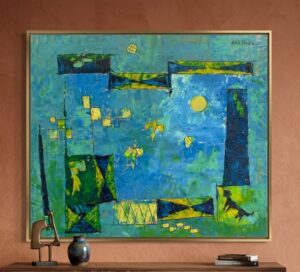
These paintings have focused on colour, texture, and light rather than subject matter. A sense of silence and contemplation has been created through minimal elements.
-
Nasreen Mohamedi – Ink and Graphite Drawings
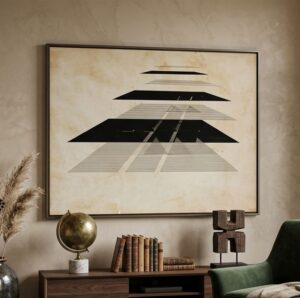
Her works have reduced visual language to lines and grids, demonstrating discipline and precision
-
S.H. Raza – Bindu Series
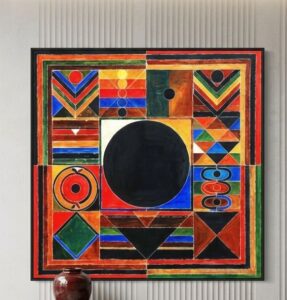
The entire composition has revolved around a single dot, transforming a simple form into a powerful philosophical symbol.
-
Warli Tribal Paintings
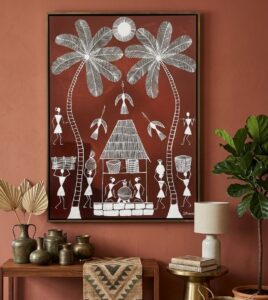
Using only white pigment on mud walls, these works have depicted daily life through basic geometric shapes.
5. Jamini Roy – Santhal Paintings
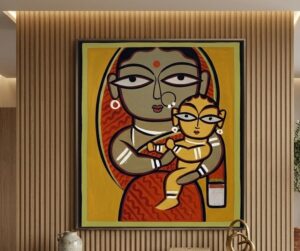
Figures have been simplified into bold, flat forms with minimal detailing, focusing on essence rather than realism.
How to Recognize Indian Minimalist Paintings
Minimalist artworks may appear simple at first glance, but they are often carefully constructed. Here are a few ways to identify them:
- Forms are simplified into basic shapes
- Colour palettes are limited and controlled
- Empty space is used intentionally
- Lines are clean and precise
- Repetition creates rhythm
- Traditional influences are subtly present
- Materials and textures feel authentic and grounded
In the Indian context, an additional layer is often present. Symbolism, spirituality, or cultural references may be embedded within the simplicity.
Final Thoughts
Indian minimalism has not been about removing meaning. Instead, it has been about refining it. By stripping away the unnecessary, artists have been able to reveal deeper truths.
While Western minimalism has often celebrated objectivity and industrial precision, Indian minimalism has leaned toward introspection and philosophy. It has drawn from centuries of tradition while remaining relevant in contemporary practice.
Today, as visual overload continues to define modern life, the relevance of minimalism has only grown stronger. Indian minimalist art, in particular, offers something rare. It provides stillness without emptiness, simplicity without loss, and beauty that feels both grounded and timeless.
Giftex: Modern and Contemporary Art Auction
This April, Giftex unveils its highly anticipated Modern Indian Art Auction, bringing together exceptional masterpieces and exciting art treasures from some of India’s most celebrated artists.
From iconic names to rare finds, every piece tells a compelling story of creativity and culture. Art lovers and collectors alike will not want to miss this remarkable event.


About Post Author