Inked Tales: The Timeless Art of Pen and Ink Drawings
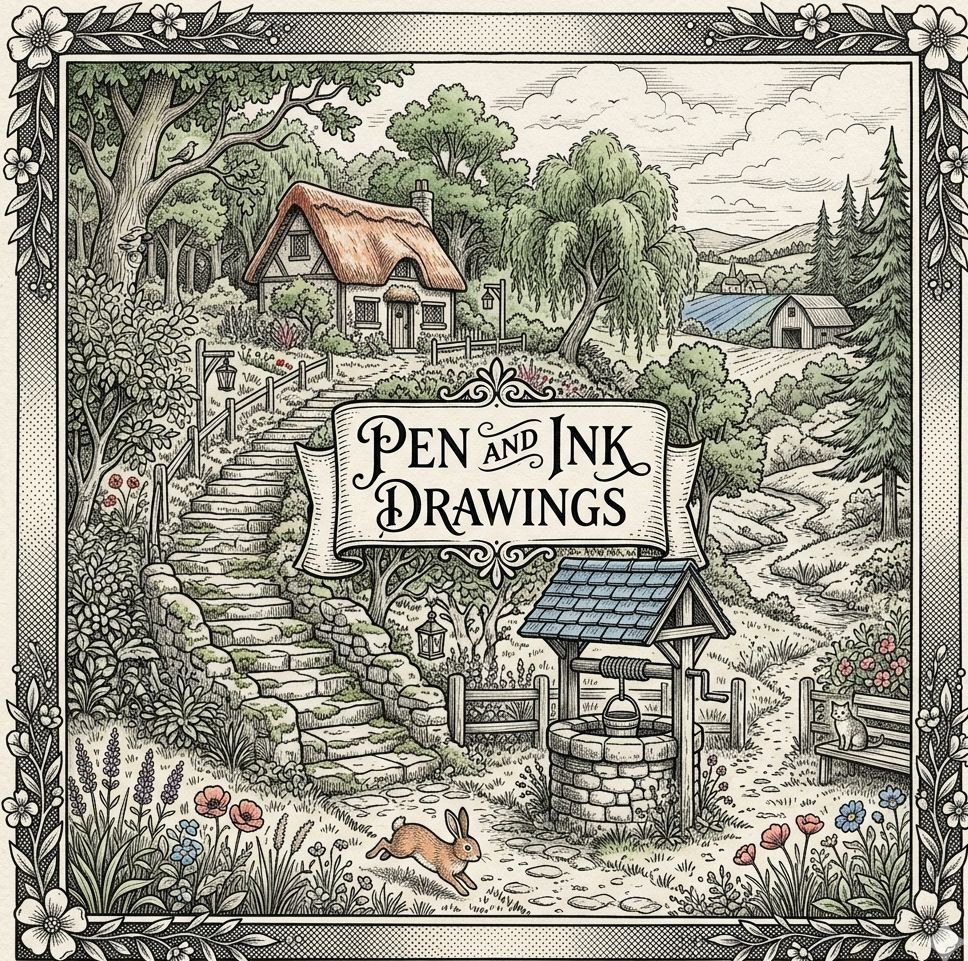
In the vast realm of fine art, few techniques evoke the timeless elegance and versatility of pen and ink drawings. From ancient manuscripts to modern sketchbooks, pen and ink art has been quietly shaping visual culture for centuries. Its simplicity is deceptive. With just ink and a pen, entire worlds can be constructed through line, texture, and contrast.
Pen and ink are ancient medium that have been used for both writing and artistic expression across civilizations. Despite the rise of digital tools, it continues to hold its place in contemporary art due to its precision, permanence, and expressive potential. In this blog, the technique, history, tools, and evolving Indian context of pen and ink drawings will be explored in depth.
Also Read: Top 10 Most Expensive Paintings Sold In India
What Are Pen and Ink Drawings?
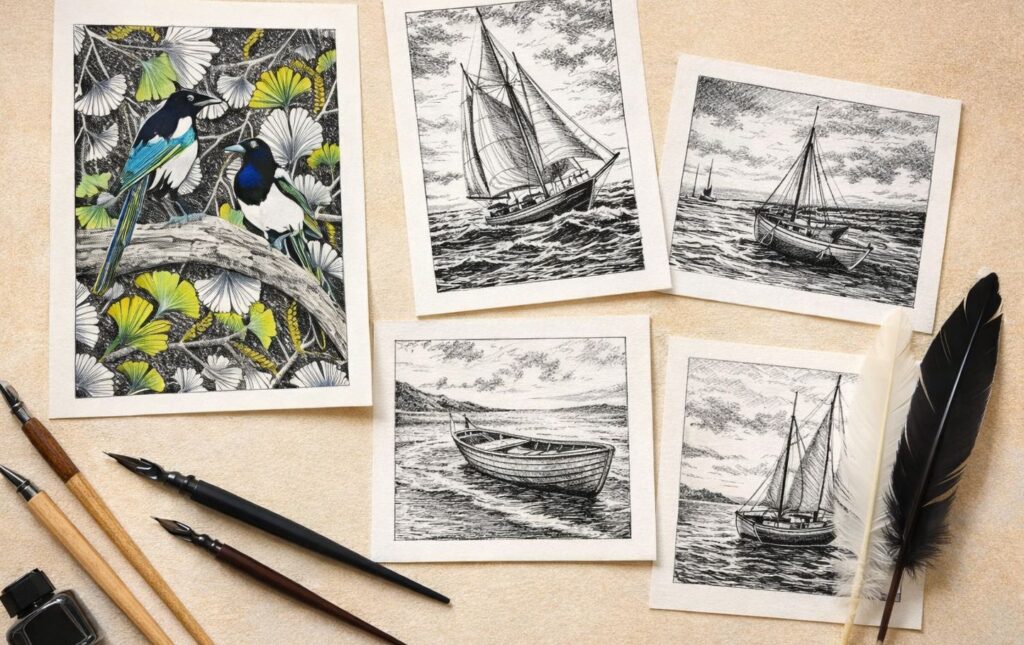
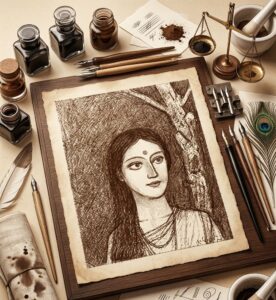
In fine art, the term “pen and ink” refers to a drawing technique in which black or coloured inks are applied to a surface, typically paper, using tools such as dip pens or reservoir pens. This medium is known for its clarity and definition. Pen and ink drawings are usually noted for bold contrasts, detailed work, and expressive lines.
A Brief History of Pen and Ink Drawings
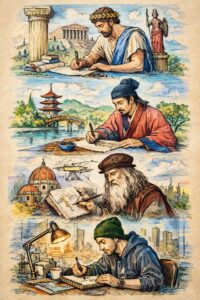
The origins of pen and ink drawing can be traced back to ancient civilizations.
In ancient Greece, ink was used for detailed drawings. One of the earliest known examples is a fragmented ink drawing on papyrus depicting The Abduction of Briseis.
-
Asian Influence
In China and Japan, ink became a dominant artistic medium. Traditional Chinese ink painting, often executed on paper or silk, emphasized mastery of brushwork and simplicity of form. \
-
Renaissance Revival
During the Renaissance, pen and ink drawing flourished as artistic principles like perspective, anatomy, and proportion were refined.
-
Later Developments
In the Baroque, Rococo, Romantic, and Neoclassical periods, pen and ink continued to be widely used. Artists experimented with line, shading, and composition.
-
Contemporary Expressions
Today, pen and ink art is being reimagined by contemporary artists. Traditional techniques are being combined with modern concepts, resulting in innovative works that range from hyper-detailed illustrations to abstract compositions.
-
Indian Scenario
Iconic pen and ink work by Indian artists blends traditional discipline with modern expression, featuring intricate line work from masters like Nandalal Bose to contemporary explorations by Jogen Chowdhury.
Tools of the Trade
The beauty of pen and ink lies in its minimalism, yet the tools used can significantly influence the outcome.
-
Pens
Pens used in ink drawing are mainly divided into two core categories:
A. Dip Pens (Traditional Tools)
Dip pens do not store ink internally. The nib is dipped into ink repeatedly during use.
Types of Dip Pens:
-
Reed Pens – Among the oldest tools, used for bold and expressive strokes
-
Quill Pens – Made from bird feathers, historically used for writing and drawing
-
Metal Nib Pens – The most common today, offering a wide variety of nib shapes
Special Nibs:
-
Crow Quill Nibs – Used for extremely fine lines
-
Mapping Nibs – Ideal for intricate detailing and precision work
These pens are preferred for their flexibility and variation in line quality.
B. Reservoir Pens (Modern Ink Pens)
Reservoir pens contain an internal ink supply, enabling continuous drawing without the need for dipping.
Types of Reservoir Pens:
-
Fountain Pens – Smooth flow, suitable for both writing and sketching
-
Technical Pens – Provide consistent, precise lines; widely used in illustration and architecture
-
Brush Pens – Combine the flexibility of a brush with the convenience of a pen
C. Fibre – Tipped Pens & Markers
Although often grouped with pens, these are better treated as a separate category due to their distinct function.
- Provide uniform, quick-drying lines
- Commonly used in graphic design, illustration, and urban sketching
- Available in a range of tip sizes for different effects
-
Brushes (For Expressive and Wash Techniques)
Brushes are not pens but are essential in ink work, especially for fluid and painterly effects.
- Used for ink washes and bold strokes
- Common in Chinese, Japanese, and Renaissance art traditions
- Allow variation in pressure, creating dynamic lines
-
Ink
Ink defines the visual strength of the artwork.
- India Ink – Deep black, waterproof, and permanent
- Coloured Inks – Used for creative and contemporary styles
- Diluted Ink – Used in wash techniques for tonal variation
-
Paper
Paper choice directly affects the final result.
-
Smooth Paper – Best for fine details and precise lines
-
Textured/Absorbent Paper – Suitable for washes and softer effects
Key Techniques in Pen and Ink Drawing
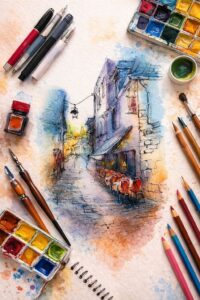
Several techniques have been developed to create depth, texture, and visual interest:
-
Cross-Hatching
Parallel lines are layered in different directions to build shadows and volume.
-
Stippling
Tiny dots are used to create tone and texture. This method requires patience but produces highly detailed results.
-
Line Work and Contour
Variations in line thickness are used to define shapes and create contrast.
-
Ink and Wash
Diluted ink is applied to create tonal gradients, often in combination with line work, to achieve a balanced composition.
Indian Scenario: Tradition Meets Innovation
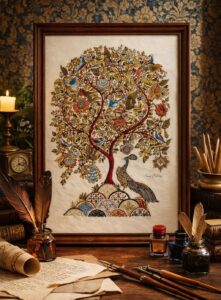
In India, pen and ink art has evolved through a blend of traditional discipline and modern experimentation. While the medium was historically used in manuscripts and folk art, it has now found a strong presence in contemporary practices.
Influential Indian Artists
-
Jogen Chowdhury
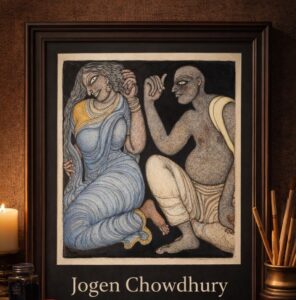
Known for detailed drawings using ink, pastel, and pencil to explore the human condition and emotions through fluid, often distorted forms.
-
Nandalal Bose
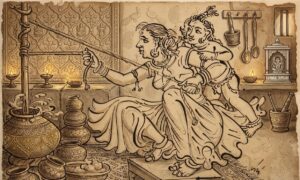
A master of delicate, flowing lines in his ink sketches, capturing rural life, Indian mythology, and folklore with grace.
-
Vishwa Shroff
Mumbai-based artist creating precise, architectural ink drawings and watercolours of forgotten buildings, featuring a unique “topsy-turvy” perspective.
-
Traditional Kalamkari & Phad Artists
Utilizing bamboo pens, these traditional methods from Andhra Pradesh, Telangana, and Rajasthan offer iconic examples of narrative art.
-
Ganesh Pyne
His work includes mysterious, dark drawings that delve into mythology and the human psyche.
Key Trends in Indian Ink Art
Several trends are shaping the Indian pen and ink landscape:
-
Kalamkari (“pen craft”): Uses bamboo pens and natural dyes to create storytelling scrolls and narrative scenes.
-
Ballpoint Pen Art: A contemporary favourite for producing highly detailed, unforgiving drawings.
-
City-Scape Art: Modern, detailed ink drawings utilizing cross-hatching to define urban landscapes in India.
-
Ink Drawing: Mark-making with Indian ink, often using techniques like stippling and hatching to create texture and form
-
Folk Fusion: Traditional Indian motifs are being combined with contemporary ink techniques, resulting in unique hybrid styles.
-
Surrealist Automatic Drawing: This technique involves spontaneous creation without conscious control.
On A Concluding Note,
Pen and ink drawing is more than just a technique. It is a tradition that has been carried across centuries, cultures, and artistic movements. From ancient manuscripts to contemporary Indian art, its relevance has never faded.
Whether used for detailed illustrations, expressive sketches, or experimental works, pen and ink continue to inspire artists around the world.
As new generations of artists explore this medium, it is being constantly redefined. Yet, at its core, it remains rooted in the power of line, the beauty of contrast, and the endless possibilities of imagination.
Giftex: Modern and Contemporary Art Auction
This April, Giftex unveils its much-anticipated Indian Modern and Contemporary Art Auction, bringing together a refined selection of exceptional artworks for discerning collectors and art enthusiasts. Known as one of India’s most trusted online auction platforms, Giftex presents a thoughtfully curated showcase of iconic and emerging Indian artists.


About Post Author