
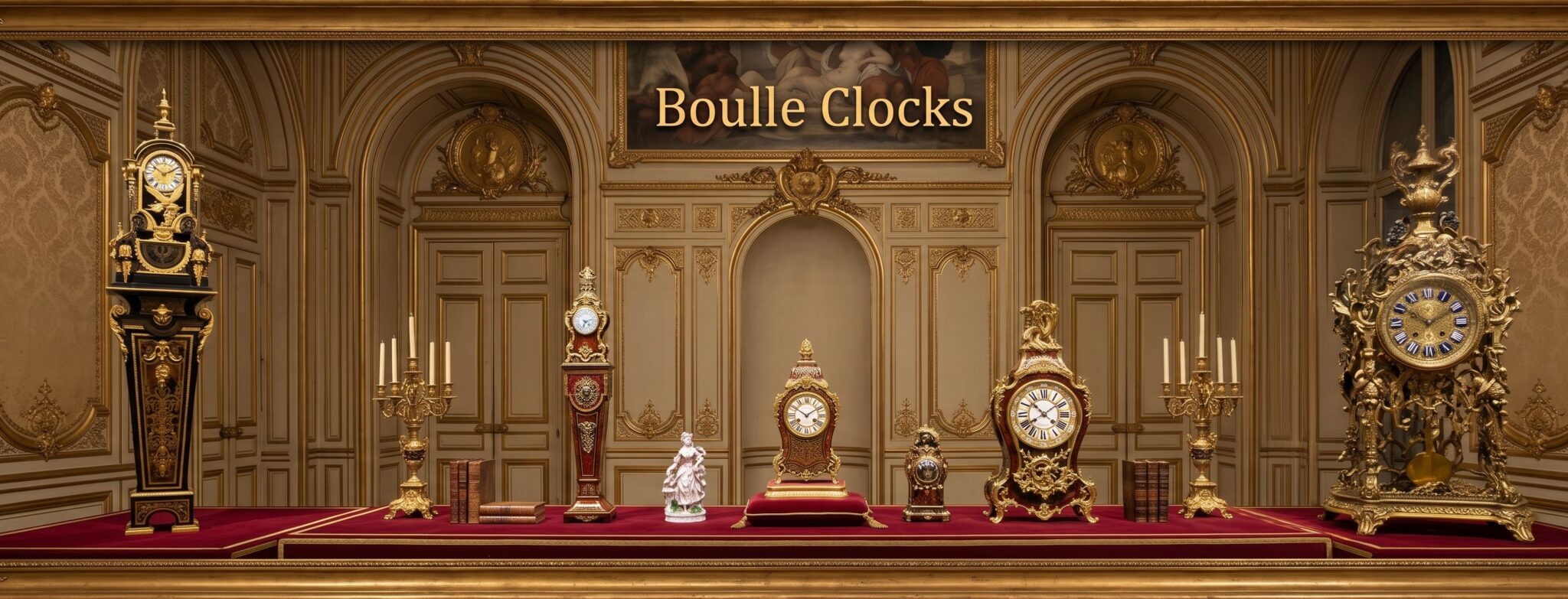
How to Identify Authentic French Boulle Clocks Like an Expert
In the world of clock making and time keeping, French Boulle clocks are among the most elegant and collectible timepieces ever made.
Known for their ornate cases, fine mechanical movements, and refined artistry, these clocks often graced the mantles and rooms of aristocracy and royalty.
The invention of Pendulum clocks by Dutch scientist Christiaan Huygens in 1656 can be considered as one of the greatest inventions of the 17th century.
With the Sun King, Louis XIV, being presented with this incredible mechanical marvel, it soon became the pride of noble and royal households. Its large size ensured that pendulum clocks were considered as a piece of decorative furniture. Thus, its production became the combined work of both the clock makers and cabinet makers, who were responsible for making the clock cases. One such cabinetmaker whose influence spread from the courts of the Sun King to throughout the world was André Charles Boulle.
Alongside his work as a royal furniture maker, Boulle also turned his attention to the clock, making elaborately decorative cases for clocks.
Whether you’re restoring a French Boulle clock or buying one at an auction, this guide will show you how to identify authentic Boulle clocks with confidence.
The History of Boulle Work
Boulle work is an elaborate marquetry technique that involves veneering furniture with a combination of metal and horn, tortoiseshell, ivory, or mother-of-pearl.
The French cabinetmaker André-Charles Boulle (1642–1732) is recognised as the principal and most accomplished practitioner of this technique. As a result of his prolific and inspired work, the terms “boulle work” or “boulle marquetry” are used to describe this type of furniture decoration.
Who Was André Charles Boulle?
Boulle was a French cabinetmaker, the master of a distinctive style of furniture, much imitated, for which his name has become a synonym. He was employed for many years at Versailles. When the ever increasing popularity of pendulum clocks called for larger clock cases, Boulle saw the opportunity to create bold and sumptuous designs.
What Are French Boulle Clocks?
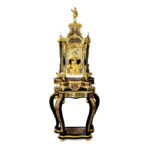
French Boulle Clock
French Boulle clocks are highly ornate, 17th- and 18th-century French timepieces famous for their signature marquetry, a technique of inlaying brass, pewter, and tortoiseshell. Named after André-Charles Boulle, these opulent clocks combine scientific precision with lavish mythological and historical symbolism.
The Signature Technique
1. The “Boulle” Look: The clock cases are covered in a decorative overlay made by sandwiching sheets of tortoiseshell (usually turtle shell) and brass. A pattern is cut out, creating two versions:
Première-Partie: Brass patterns placed against a tortoiseshell background.
Contre-Partie: Tortoiseshell patterns placed against a brass background. These surfaces often display scrolling foliage, floral motifs, arabesques, and symmetrical ornamentation.
2. Gilt Bronze: The wooden cases are heavily mounted with intricately cast, gilded bronze (ormolu).
Design and Symbolism
• The Sun King (Apollo): Many clocks are crowned with allegorical figures representing Apollo, the Greek god of the sun, arts, and music.
• Father Time: The pinnacle of these clocks frequently features a bearded old man (representing time or Chronos/Saturn) scythe in hand or seated on a globe, highlighting the irreversible passage of mortal life and the universality of the universe.
• Cosmic & Mythological Tributes: Designs often feature scenes of Roman gods (such as Venus and Cupid) or the heavens upheld by Atlas, grounding human timekeeping in the classical understanding of eternal cosmic cycles.
Identifying Authentic Boulle Clocks
Identifying an authentic French Boulle clock requires examining its case construction, marquetry, and movement.
1. The Clockmaker’s Signature
French clockmakers often left subtle marks to indicate their identity. Check both the movement and dial for:
• Maker’s name or initials
• A stamped medallion or logo
• Place of manufacture
Location: The maker’s name is usually stamped or engraved directly into the metal backplate of the clock movement, or on the front porcelain dial.
Be cautious, some reproductions mimic old markings. Use a magnifier to inspect font style, stamping depth, and wear. Real stamps are clean but aged; fake ones often look too perfect.
2. Evaluate the Marquetry (Brass & Shell)
André-Charles Boulle pioneered a technique of cutting brass and tortoiseshell together. Authentic tortoiseshell has a natural, mottled depth (often stained red) rather than uniform plastic or celluloid.
Hand-Cut Precision: Authentic antique Boulle work is cut by hand. Look for tiny discrepancies in the floral or scrolling patterns. Modern reproductions from the late 20th century typically use laser-cut or stamped metals that look unnaturally perfect.
3. Inspect the Ormolu (Gilded Bronze)
Quality: Boulle clocks are famous for their heavy, sculptured gilt bronze or ormolu mounts.
Authentic 18th-century pieces used mercury-gilding, which is highly luminous. The bronze details (like masks of Apollo or acanthus leaves) should feel extremely crisp and sharp to the touch, as they were hand-chased after casting.
Patina: Look for natural, age-appropriate wear and oxidization in the crevices of the bronze rather than a uniform, bright modern gold plate.
4. Examine the Clock Movements
Maker’s Marks: Carefully remove the rear access panel to inspect the brass back plate of the clock movement. Authentic French clocks almost always bear the maker’s name, a serial number, and/or exhibition medallions
Pendulum: Verify that the pendulum is original to the clock. The shape often matches the clock’s design.
Hand-Finished Parts: Authentic antique clock movements feature hand-filed gears and irregular tool marks, unlike mass-produced factory movements from the mid-20th century onwards.
5. Dating and Authenticity
Age of the Wood: Examine the carcass wood inside the clock. Older pieces will show signs of age, including a dark patina, hand-planed surfaces, and slight shrinkage of the wood.
Victorian Revivals: Be aware of the “Napoleon III” period (mid-19th century) or Victorian-era revivals. These items are still antique and valuable, but they are technically reproductions of earlier Louis XIV or Louis XV styles, not pieces made by Boulle himself.
6. Check Provenance and Documentation
A clock with documented provenance is generally more desirable and trustworthy.
Useful documentation may include:
• Auction records
• Antique dealer certificates
• Restoration history
• Estate records
7. Consider Consulting a French Clock Expert
Sometimes, despite your best efforts, determining an exact date requires a second opinion. Complex restorations, mismatched parts, or rare makers may not appear in standard databases.
If you’re stumped, consider reaching out to horological forums or collectors’ groups. You can also consult with a professional.
Concluding Thoughts
Boulle clocks are among the most magnificent decorative antiques ever created. Combining technical mastery, luxurious materials, and artistic brilliance, these extraordinary timepieces continue to fascinate collectors centuries after their creation.
Identifying an authentic Boulle clock requires close attention to craftsmanship, materials, clock movements, and historical details.
Whether admired for their investment value, decorative beauty, or historical significance, Boulle clocks remain timeless masterpieces that continue to define elegance in the world of antiques and horology.


About Post Author