The Art and Elegance Behind Art Deco Jewellery
Every era produces unique styles and trends. However, only a few eras and designs stand the test of time to become classics.
The 1920s, often referred to as the “Roaring 20s”, were a time of great prosperity and innovation—including a striking new aesthetic in jewellery. Post-World War I, a new jewellery style emerged. The Art Deco jewellery movement saw luxurious materials and sleek, geometric designs become mainstream.
New global influences, new technologies, new art, and new materials all came together to define this crucial moment in jewellery design.
The Art Deco style, heavily influenced by the period’s architecture and geometrical shapes, produced some of the most elegant and astonishing jewellery trends ever.
Today, Art Deco remains one of the most sought-after vintage styles.
So, let’s travel back in time, to the “Roaring 20s” and look at the Art Deco jewellery, the design, styles and features that define this era.
Also Read: Parure: The Magic of Matching Jewellery Set
Origin of the Art Deco Era
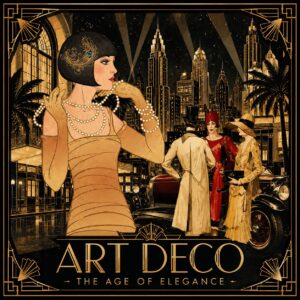
As the world was slowly coming out of the war tragedies, fashion took a more playful, exquisite, and pragmatic turn.
The end of the First World War heralded a revolt against the excesses of the previous eras. The war had ravaged European cultural centres, women had stepped in to fill industrial roles left vacant by men, and the wealth of the nobility had been severely dented. In this rapidly changing environment, the Art Deco era emerged.
The style that we call “Art Deco” received its name from the Exposition International des Arts Decoratifs et Industriels Modernes.
Art Deco Jewellery: The Union Of Form and Fashion
To fully appreciate the exquisiteness of Art Deco jewellery, it is necessary to understand the characteristics and features that make it so sought after.
Art Deco jewellery is defined by geometric shapes, stark symmetry, and bold colour contrasts. It represented a modern departure from the soft, organic curves of the earlier Art Nouveau era, embracing the sleek, industrial aesthetic of the machine age.
Features Of Art Deco Jewellery
Art Deco flourished between the 1920s and 1930s, shaped by a world stepping confidently into modernity. What emerged was a style that felt optimistic, forward-looking and quietly glamorous.
- Bold Geometry: The Signature of Art Deco
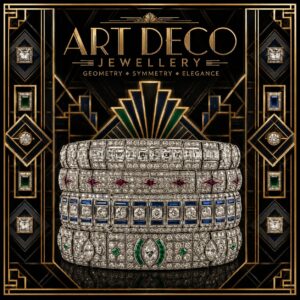
Perhaps the most recognisable characteristic of Art Deco jewellery is its devotion to geometry.
Art Deco jewels embraced modernism and the advances in technical innovation and machinery. A new genre of design was born – bold, geometric shapes with clean lines and symmetry.
The jewellery featured:
- Clean vertical lines
- Perfect symmetry
- Step-like forms
- Rectangular and square silhouettes
- Angular settings
- Platinum
Art Deco coincided with the widespread use of platinum, a metal prized for both its strength and subtle sheen. Use of platinum led to light, airy gemstone designs without as much metal required.
Because of its strength and malleability, it was well-suited to the fine filigree work and millegrain detailing characteristic of the crisp geometric designs of the period.
- Gemstones
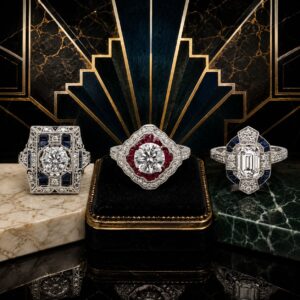
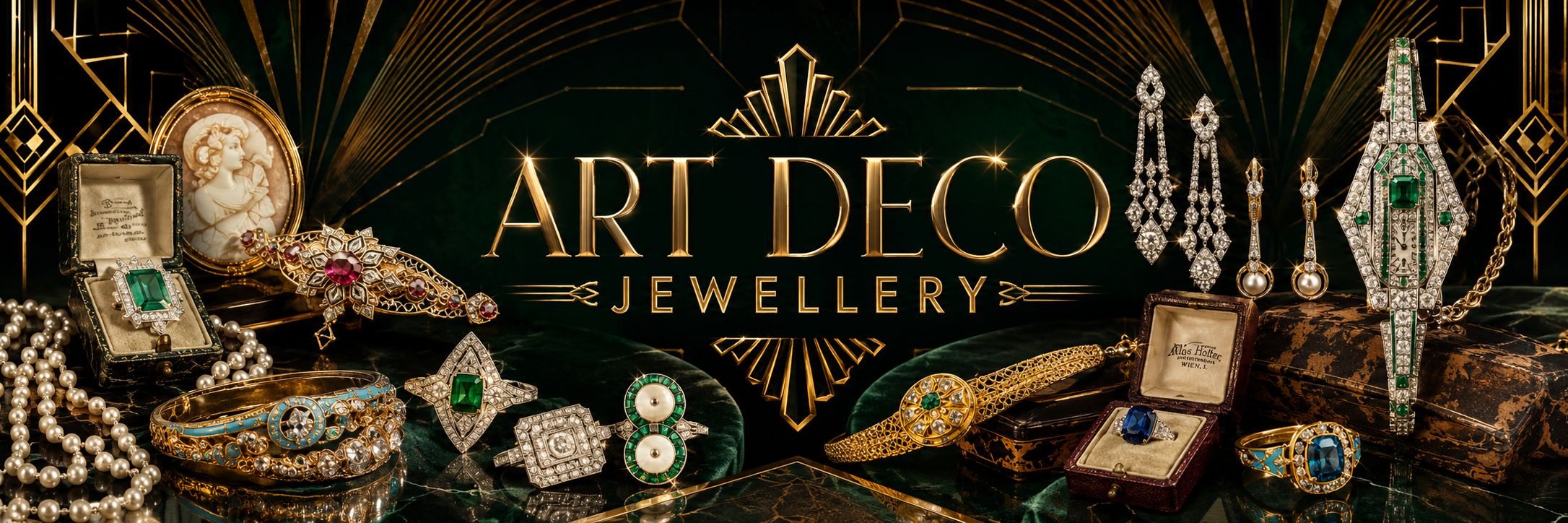
Though icy white diamonds and glossy black onyx made frequent appearances in Art Deco jewels, there were also plenty of other coloured gemstones that were popular.
Expect to see diamonds paired with:
- Deep blue sapphires
- Lush green emeralds
- Rich rubies
- Dramatic black onyx
- Invisible Settings
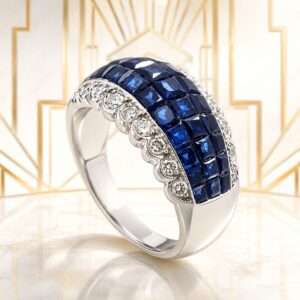
Jewellery giant, Van Cleef & Arpels, developed the significant ‘mystery setting’ or serti invisible (“invisible setting”) which allowed gems to be mounted in such a way that no metal was visible.
- New Inspiration and Cuts
The need to break free from the unnecessary extravagance of the past and incorporate modernism led gem cutters to cut and shape gems in new and exciting ways. Gem cutters achieved brilliance from faceted gems by creating new shapes (trapezoids, half-moons, and triangles) that could be arranged in mosaic-like designs.
- Striking Symmetry and Balance
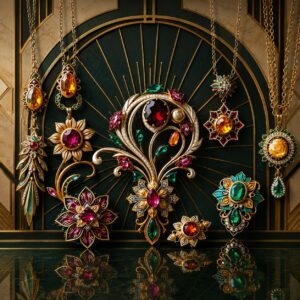
Art Deco jewellery embraces balance with near mathematical precision. Stones are often set in mirrored arrangements, with deliberate repetition.
- Lacquer
Enamelling – which was labour-intensive and expensive – was replaced by sophisticated lacquer techniques from the Far East.
- Synthetic Materials
Synthetic materials such as Bakelite became widely available and were used to imitate gemstones, amber, wood, bone and other natural materials.
- International Influence
Cultures around the world influenced the Art Deco era and introduced new jewellery trends.
The ‘Egyptian Revival ‘stands out in particular. Exciting new archaeological discoveries in Egypt, primarily the tomb of Tutankhamen, had a huge influence on Art Deco design motifs.
Designers also adapted materials particular to Asian jewellery, such as jade, coral, enamels, lacquer and pearls.
- Motifs
The global culture influenced Art Deco jewellery creation with motifs ranging from Egyptian revival style to Asian patterns.
Lotus blossoms, scarabs, pyramids and the eye of Horus are among the ancient Egyptian motifs that can be spotted in Art Deco jewellery.
Flora and fauna, as well as Asian and African influences, played an important role.
Art Deco Jewellery Styles
Here are some popular types of Art Deco jewellery:
- Art Deco Earrings
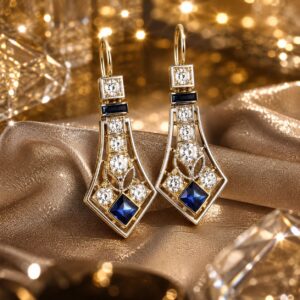
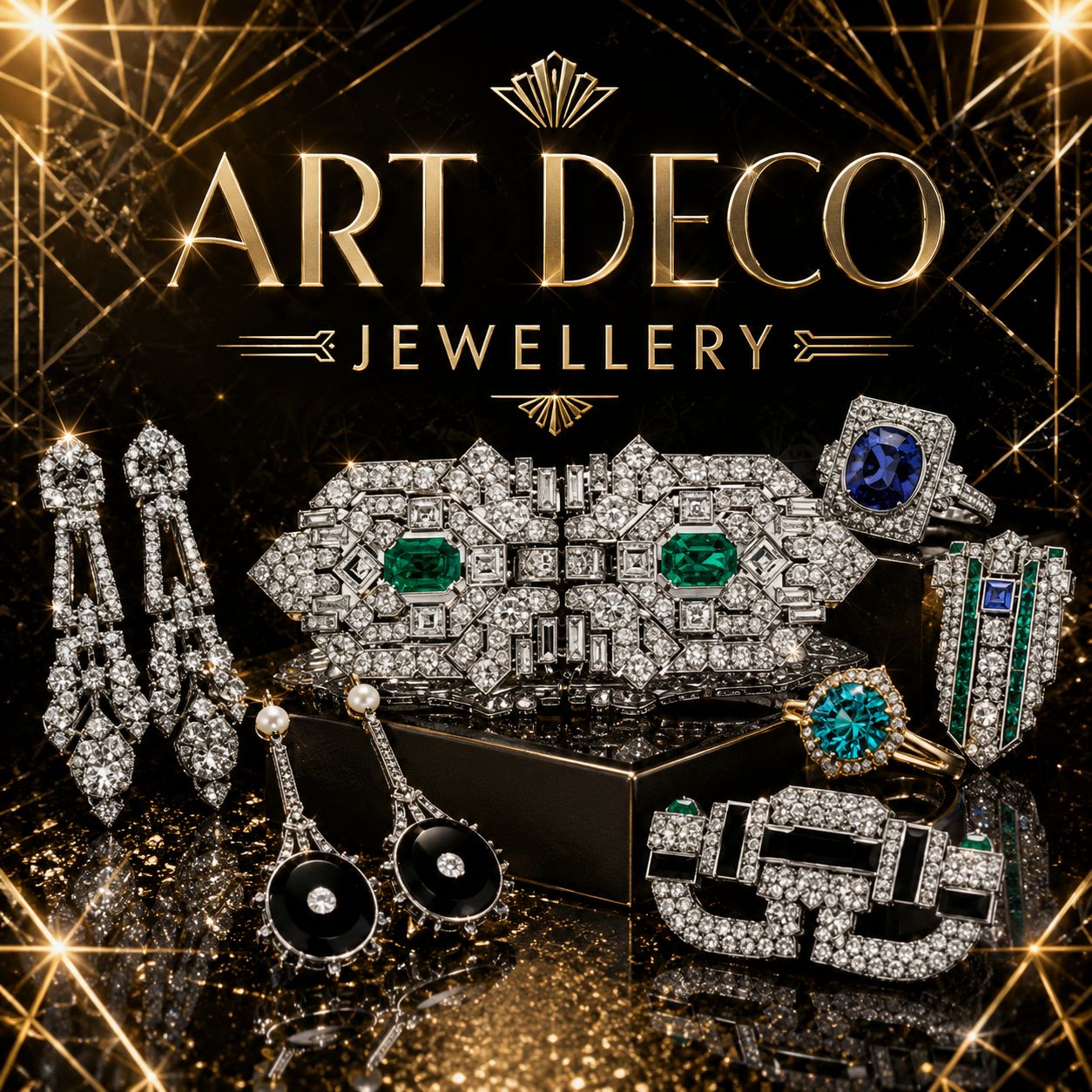
Early Art Deco earrings were long and delicate, exposed by the new, short hairstyles. They tended to be geometrically shaped, with diamonds and perhaps a large, coloured gemstone.
- Cocktail Rings
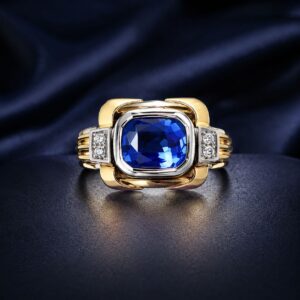
Large, flat, or elongated “dinner rings” featuring intricate geometric patterns were all the rage during the Art Deco era.
- Necklaces
The iconic necklace for the 1920s was the sautoir. These were extremely long and often featured a tassel or a pendant. They were designed to be worn long, sometimes draped down the back to match the open backs of flapper dresses.
Pearl necklaces made using cultivated pearls were widely worn during the day and evening.
- Pendants
Pendants were a significant feature of Art Deco jewellery. Designs were often geometric and featured patterns and materials influenced by Chinese, ancient Egyptian and Indian cultures.
- Geometric Brooches
Brooches were incredibly versatile during the Art Deco era. These were worn on lapels, hats, and even to hold draped fabric together. Popular styles include openwork geometric shapes, stylized floral or Egyptian-revival motifs, and “clip brooches” that could be worn individually on either side of a neckline or joined to form a single large centerpiece.
- Art Deco Rings
Art Deco rings are celebrated for their bold elegance, striking geometry, and sophisticated craftsmanship. Platinum and white gold settings enhanced the brilliance of the stones, while contrasting gems such as sapphires, rubies, emeralds, and onyx added dramatic visual appeal.
- Bracelets
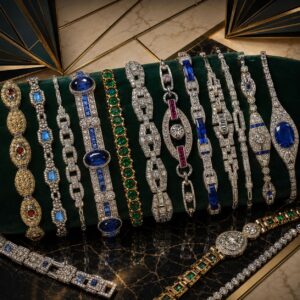
Before the modern tennis bracelet, the Art Deco era favoured articulated line bracelets. These flexible bands were highly stylized, featuring repeating geometric links set with diamonds and accented by strips of rich black onyx, deep blue sapphires, or ruby calibrations.
Narrow bangles were stacked and jingled along to the jazz music of the day, as did the popular charm bracelets.
- Hair Ornaments
English court etiquette dictated that tiaras be worn and so they were produced with Art Deco design motifs and techniques for state events.
How to Recognise a Genuine Art Deco Jewellery
When exploring vintage jewellery, several distinctive features can help identify an authentic Art Deco piece:
- Strong Geometric Patterns
- Balanced and Symmetrical Layouts
- Platinum settings
- Use of white gold
- Emerald cuts, baguette cuts, and other innovative gem cuts
- Use of Coloured Gemstones such as sapphires, emeralds, etc.
- Fine Milgrain Detailing
The Enduring Appeal of Art Deco Jewellery
The enduring appeal of Art Deco jewellery lies in its remarkable ability to blend artistic innovation with timeless elegance. Emerging during an era of cultural transformation and modern optimism, these pieces reflected a bold new vision of luxury through geometric precision, striking contrasts, and exceptional craftsmanship. Even today, Art Deco jewellery continues to captivate collectors, designers, and enthusiasts with its sophisticated glamour and distinctive character.


About Post Author