From Parisian Echoes to Linear Patterns: The Stylistic Transformation of M. Reddeppa Naidu
The history of modern Indian art is marked by artists who sought to bring together complex ideas between global artistic movements and indigenous cultural traditions. Among these figures, M. Reddeppa Naidu occupies a distinctive position.
Born in a small village in Andhra Pradesh, Mopuri Reddeppa Naidu (1932–1999) was a celebrated Indian painter and artist. A pioneering Indian modernist painter, his work reflected not just his rural upbringing, but also his urban and artistic sensibilities. He was known for his unique fusion of Indian mythology with modern artistic styles.
Throughout his artistic career, M. Reddeppa Naidu’s quest was to transform and update traditional and religious Hindu subjects into modern images, not unlike what Raja Ravi Varma attempted a century before.
What makes Naidu’s artistic journey particularly compelling is the evolution of his style. His work reflects a gradual yet deliberate movement away from the influence of European modernism toward a uniquely Indian visual vocabulary.
The story of M. Reddeppa Naidu is one of artistic evolution, cultural exploration, and creative independence.
Early Life
Born in 1932 in a village in Andhra Pradesh, in the East Godavari district, his cultural environment played an important role that reflected in his art.
He received his formal education in Kakinada and attended the Madras College of Arts and Crafts.
In 1960, he received his Diploma in painting from the Government School of Arts and Crafts, Chennai, Government of India.
It was here that K. C. S. Paniker, an Indian metaphysical and abstract painter from Malabar District, mentored him.
The Artistic Climate of Post-Independence India
The decades following India’s independence in 1947 witnessed a period of intense experimentation within the country’s art world.
In the 1950s and 1960s, many Indian artists grappled with the tension between indigenous artistic traditions and the growing influence of Western modernism. They sought to define what it meant to be “modern” within an Indian context.
It was within this dynamic atmosphere that Naidu’s artistic vision began to take shape.
Naidu took the path of forsaking Western modernism for images from Hindu mythology and religious iconography in the ’70s.
Naidu’s early works reveal an awareness of Western modernist aesthetics. Unlike many artists who adopted Western modernist styles wholesale, Naidu approached these influences selectively. His engagement with modernism was analytical rather than imitative.
Early Influences and the Echoes of Parisian Modernism
Naidu refined his skills while he studied under the influential artist K.C.S. Paniker.
Paniker played a crucial role in encouraging young artists to explore new visual languages while remaining connected to Indian cultural traditions. This distinction would become increasingly important as his artistic practice matured.
Indian artists, in that era, were quite obsessed with Parisian modernism. But Naidu says that the great European experiment did not really influence his works.
The Search for an Indigenous Artistic Identity
As Naidu’s career progressed, his attention shifted toward questions of cultural identity and artistic authenticity. He became increasingly interested in exploring themes drawn from Indian mythology, religion, and visual traditions. For Naidu, mythology offered a rich reservoir of narratives, symbols, and philosophical ideas.
He sourced his images and inspiration from the world around him. He made a beginning with Indian icons, which he saw everywhere. He drew a lot from Indian mythology and temples. From the roadside temples, for instance, he took the images of Durga sitting on a lion. Besides Durga and Vekateshwara, he also extensively painted Ganesha.
This shift marked the beginning of a significant transformation in his artistic language.
The Emergence of Linear Patterns as a Signature Style
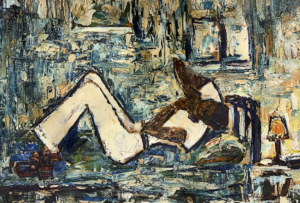
M Reddeppa Naidu Painting
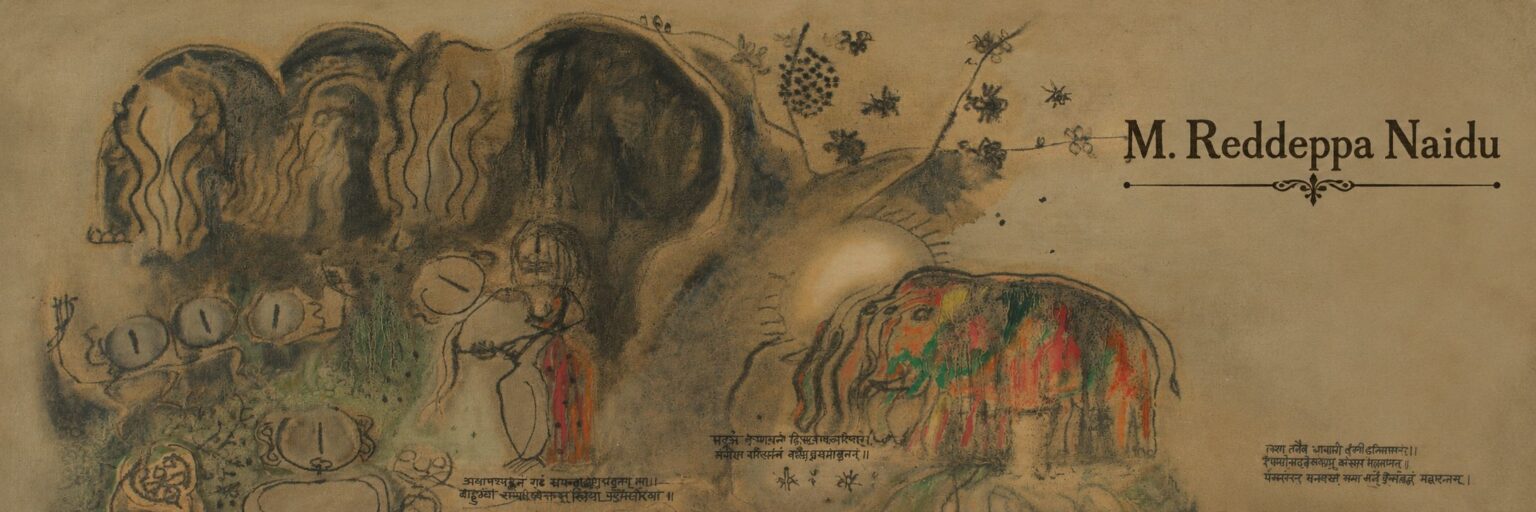
One of the defining characteristics of M. Reddeppa Naidu’s paintings is the central role played by line. His mature works feature bold, lyrical linear outlines, muted yet rich colour palettes, dry brush strokes, and Cubist approaches to space and iconography. These linear structures create a sense of rhythm and movement that animates the entire surface of the painting.
Unlike traditional contour drawing, Naidu’s lines serve multiple functions simultaneously. They define forms, establish spatial relationships, generate decorative patterns, and create emotional resonance. The result is a visual language that is both highly structured and remarkably fluid.
Through his mastery of line, Naidu developed a style that was immediately recognizable and entirely his own.
Mythological Focus
Perhaps no aspect of Naidu’s work demonstrates his artistic transformation more clearly than his treatment of mythology.
Naidu’s most notable work is his series of 18 large canvases depicting the Mahabharata, executed between 1972 and 1974. This was followed by his works depicting Ramayana and Musicians. The emphasis is not simply on recounting stories but on conveying their emotional and philosophical dimensions. This monumental project showcases his mastery of Indian mythology and his unique artistic style.
The Mahabharata work was inspired by a fortuitous encounter between the painter and his Telugu poet friend M. Deendayal.
On the other hand, it was the Bishop of Madras, Lesley Newbigin, who commissioned Naidu to paint the Church Hall, thus sparking his interest in the New Testament, the incarnation of Christ, and finding the deeper meaning of Christianity.
This fusion of mythology and modernist aesthetics enabled Naidu to create works that were simultaneously contemporary and deeply rooted in Indian cultural memory.
Architecture and Spatial Imagination
Architecture occupies a prominent place throughout Naidu’s artistic career. Churches, cathedrals, temples, and monumental structures frequently appear within his compositions.
These subjects provided opportunities to explore geometry, pattern, and spatial organisation. In many works, buildings transcend their physical identities and become symbolic constructions.
Painting Style
In several of his works, Naidu has painted with a palette knife on canvas, using pastel shades. But mostly, he prefers the medium of oils on fine-grained canvas. He moved on from painting too much of naturalistic modelling to a linear and cubistic approach. Somewhere in the 70s, Naidu also turned his back on the Western impressionist style of art and brought in a lot of Indian motifs and styles, like the miniature style, into his works.
The Influence of Craft Traditions
Textile and other regional craft forms deeply enchanted Naidu throughout his career. The artist himself likened the use of scripts within the body of his paintings as a kind of ‘weft work’ which reminds us of the proximity between the two words, ‘text’ and ‘textile’
Naidu’s long stint at the legendary Weavers’ Service Center in Madras (now Chennai), where he retired as deputy director after twenty-seven years of service, made him a stalwart of the craft revival movement in postcolonial India.
The woven quality evident in many of his paintings reflects this engagement with craft traditions.
Institutional Impact & Legacy
Group 1890: He was the only “Madras Modernist” to be a part of this avant-garde, pan-Indian collective of artists.
The Weavers’ Service Centre (WSC): He worked at the legendary WSC in Chennai for 27 years, playing a crucial role in India’s postcolonial craft revival movement.
Cholamandal Artists’ Village: He was closely associated with this pivotal community, serving as president of the Progressive Artists’ Association.
Legacy and Continuing Relevance
Today, M. Reddeppa Naidu is widely regarded as one of the pioneers of South Indian modernism. His contribution extends beyond his individual body of work. Collectors value his works for their distinctive aesthetic qualities, while historians recognize their importance within the broader narrative of Indian modernism.
Final Thoughts
Linear patterns remain the defining hallmark of M. Reddeppa Naidu’s artistic practice. Through his masterful command of line, he elevated figurative painting to new heights of expressive power. Executed often with a dry brush, his lines possess a distinctive lightness and irregularity, lending his works a sense of spontaneity and movement.
Until his passing in 1999 at the Cholamandal Artists’ Village, Naidu remained committed to exploring the possibilities of form, line, and cultural memory. His artistic journey, from the influence of European modernism to the creation of a deeply personal visual language rooted in Indian mythology and tradition, stands as one of the most compelling narratives in modern Indian art.


About Post Author