The Neo-Tantric Art of Prafulla Mohanti: Symbolism, Circles & Cosmic Energy
Indian modern art and artists have often drawn strength from the country’s ancient spiritual traditions and symbols. Among the artists who have successfully bridged these worlds, Prafulla Mohanti stands as a distinctive voice. Through his meditative compositions, recurring circular forms, and deeply personal symbolism, Mohanti has become one of the most significant figures associated with the Neo-Tantric Art movement.
Based in London, Prafulla Mohanti (b. 1936, in Odisha), is an established and celebrated Indian writer and painter.
This blog explores the Neo-Tantric art of Prafulla Mohanti, examining the symbolism behind his circles, his fascination with cosmic energy and works that embody the essence of Neo-Tantrism.
Early Life
Prafulla Mohanti was born in Odisha, India. His upbringing in the village of Nanpur, where art and daily life were intertwined through religious and social ceremonies, remains important to his work.
This gave him an early sensitivity towards symbols and sacred imagery. After studying architecture at Bombay University, he pursued a Diploma in Town Planning from Leeds University in the UK. It was here that he began his artistic practice. He also taught yoga and classical dance to local communities, and later, his artistic practice expanded to incorporate writing and community projects.
Despite decades abroad, the memories of his childhood village remain central to his artistic vision. His paintings repeatedly revisit symbols, colours, and spiritual concepts that originated in Odisha’s cultural landscape.
Artistic Inspiration
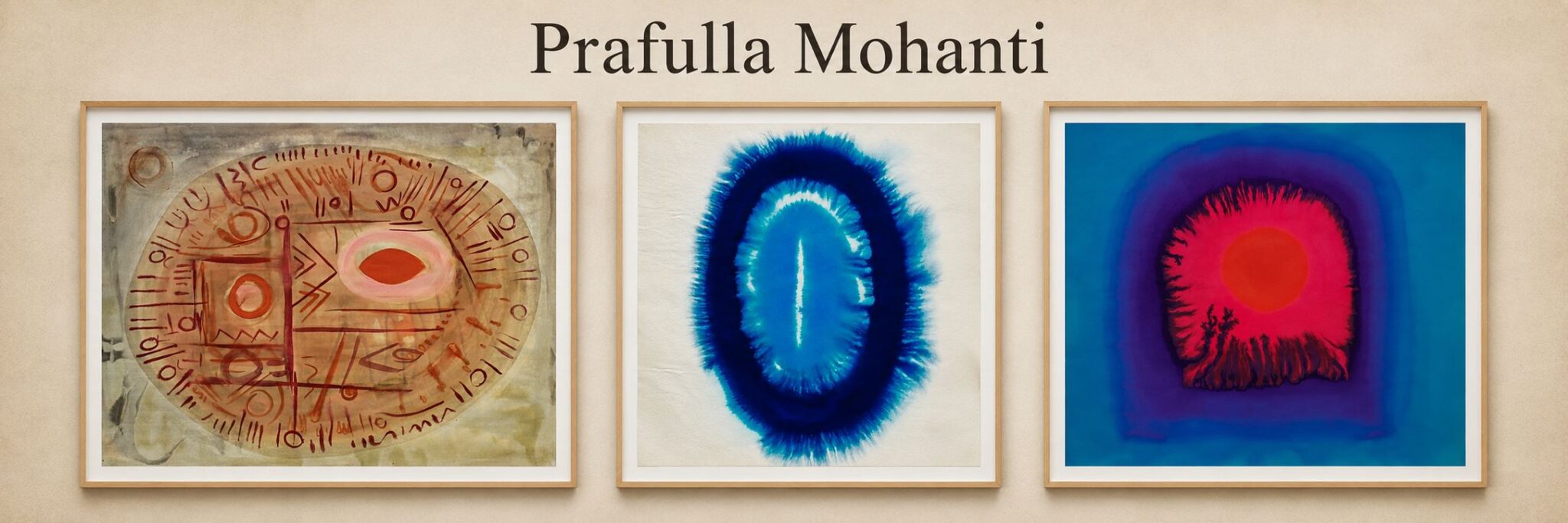
As a child growing up in a small village in Odisha, Mohanti was taught to draw three circles to represent the Hindu trinity – Brahma (the creator), Vishnu (the preserver) and Mahesh (the destroyer) – responsible for the endless cycle of creation and destruction. For Mohanti, the circle is ‘absolute abstraction’, both void and container of everything.
Mohanti’s art reflects the influence of his birthplace and childhood, with a distinctive focus on circles inspired by his childhood practice of drawing in mud. His paintings often depict elements like his mother’s vermillion spot merging with cosmic imagery. His abstract art includes symbols like the bindu, representing Shunya, and serene blue landscapes.
What Is Neo-Tantric Art?
To appreciate Mohanti’s work, it is important to understand the Neo-Tantric movement that emerged in India during the 1960s and 1970s.
Neo-Tantric Art is a mid-20th-century movement in Indian modernism that merged ancient Tantric philosophy with global abstract art. Coined by art historian Dr L.P. Sihare, it revived sacred geometry and cosmic symbols to explore the metaphysical, creating a unique visual language bridging Indian traditions and Western modernism.
Neo-Tantric art emerged in the backdrop of the Tantra revival in India. The movement represented an attempt by post-independence artists to reclaim their indigenous heritage from colonial interpretations.
Neo-Tantric art has its conceptual and visual basis in the representational motifs and symbols of Buddhist and Hindu Tantra.
Neo-Tantric works often employed:
- Sacred geometry
- Mandala-like structures
- Bindu (cosmic point)
- Triangles representing opposing energies
- Circles symbolising unity and infinity
- Vibrant colours associated with spiritual awakening
Key Characteristics
- Sacred Geometry: Uses foundational shapes like the bindu (point/dot), triangle (feminine/masculine energies), circle, and square to represent universal energies.
- Vibrant Palettes: Employs intense, primary colours—predominantly deep reds, blues, blacks, and whites—meant to awaken higher states of consciousness.
- Meditation & Cosmology: Artworks function almost as modern mandalas, designed to induce contemplation, mindfulness, and an awareness of the cosmic self.
The Circle: A Lifelong Symbol
Among the many motifs found in Mohanti’s work, none is more important than the circle.
As a child, he was taught to draw three circles to represent the Hindu trinity – Brahma, the creator, Vishnu, the preserver, and Mahesh (Shiva), the destroyer. Ritual symbols, the lotus, the bindu, sunsets and sunrises, are central elements of his work, frequently executed in reds, pinks and blues.
For Mohanti, the circle is not merely a geometric shape. It is a profound spiritual symbol representing:
- Infinity
- Cosmic energy
- Cycles of life and death
- Unity of existence
- The universe itself
Bindu And Its Symbolism
Many of his artworks also evoke the Bindu: a small dot that represents a vast and expanding Cosmos. The circle, too, is a symbol tied to many aspects of life. The artist grew up with these symbols as a part of life.
The bindu is often represented as a single point or dot and symbolises the origin of creation. In metaphysical terms, it is the source from which all forms emerge and into which they ultimately dissolve.
His paintings often appear minimal at first glance, yet they contain layers of spiritual meaning that reveal themselves through prolonged observation.
Cosmic Energy and Spiritual Abstraction
Unlike many Western abstract artists who focused primarily on form and colour relationships, Mohanti’s abstraction is deeply rooted in spiritual inquiry.
For Mohanti, painting is a form of meditation, and the efforts to control the paint’s flow can be likened to a person’s attempts to control their life.
Although deeply rooted within the Indian landscape and Tantric culture, Mohanti translates these sources through the language of abstraction to produce deeply personal paintings.
His works frequently explore the relationship between the individual and the universe. Circular forms become planets, cells, seeds, or cosmic bodies. Empty spaces become fields of possibility. Colour becomes a carrier of energy and emotion.
Artistic Expression
In his Dancing Hands series, he experimented with relating his paintings to dance, arranging coloured lighting which changed as he moved among the paintings to create an atmosphere of shared contemplation. For Mohanti, painting, writing, poetry, dance and architecture are interrelated.
His work revolves around energy symbolism, taken from rural sources. His use of complimentary colours to form patterns that reflect a proto-tantric visual language.
Famous Works Reflecting Neo-Tantric Themes
An egg and its yolk; an eye and its pupil; a yoni (womb) and its seed; a bindu (cosmic dot), a shunya (void), a mandala (sacred circle), or a globe suspended within the fathomless Brahmanda (universe)—Prafulla Mohanti’s circular forms are rich with layered meanings. His paintings draw upon the union of Purusha and Prakriti, the masculine and feminine principles whose interaction generates a universal, non-binary cosmic energy. Without beginning or end, these circles embody ananta (infinity) and paripurna (wholeness), becoming visual metaphors for creation, continuity, and the cyclical nature of existence. Each composition radiates a quiet yet profound spiritual energy, inviting viewers to experience the paradox of everything and nothing simultaneously—the fullness of the cosmos contained within a single form, and the infinite void from which all life emerges.
Prafulla Mohanti’s Legacy in Indian Modern Art
Prafulla Mohanti occupies a unique position within Indian modern art. While many artists embraced abstraction through formal experimentation, Mohanti developed a visual language deeply rooted in personal memory and Indian philosophy.
Today, his paintings continue to resonate with audiences worldwide because they address universal questions about existence, identity, and humanity’s relationship with the cosmos.
Final Thoughts
The art of Prafulla Mohanti reveals the enduring power of simple symbols. Through circles, bindus, and luminous fields of colour, he creates visual meditations that bridge personal memory and cosmic consciousness.
In an increasingly fast-paced world, Mohanti’s contemplative paintings offer something rare—a moment of stillness, reflection, and connection with the infinite.


About Post Author