Railway-Era Shawls: Weaving the Tapestry of Transformation
The history of antique and vintage shawls is often told through craftsmanship and regional identity. That approach, however, misses a critical turning point. The value and character of shawls were not changed in the loom alone. They were reshaped on the tracks.
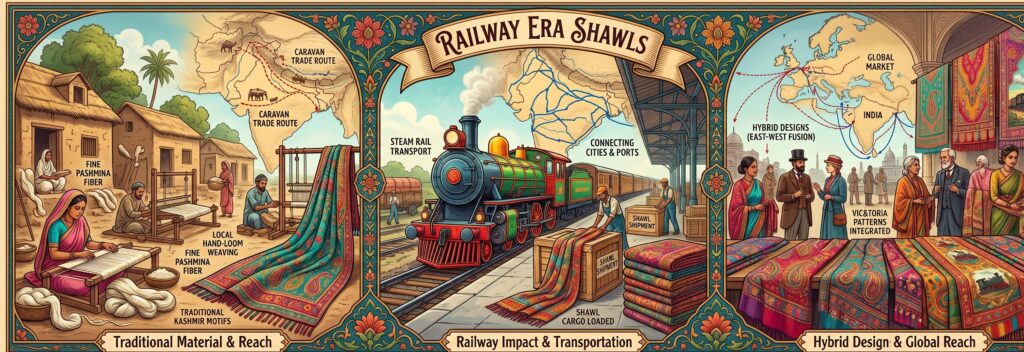
Before railways cut across India, Kashmiri shawls existed within a relatively closed system. They were slow objects. Months of handwork were required, sometimes years. Fine pashmina was spun, dyed, and woven with precision that could not be rushed. Because of this, these Pashmina shawls did not circulate widely. They moved quietly between courts, aristocratic households, and diplomatic exchanges.
Then movement entered the story.
With the introduction of railways and the expansion of trade routes in the mid-19th century, the world around shawl production began to shift. Initially, these systems were created for British administrative control and trade efficiency. Local impact was limited at first. However, as railway networks expanded, their influence spread into craft, commerce, and design.
Shawls were no longer just made differently. They began to exist differently.
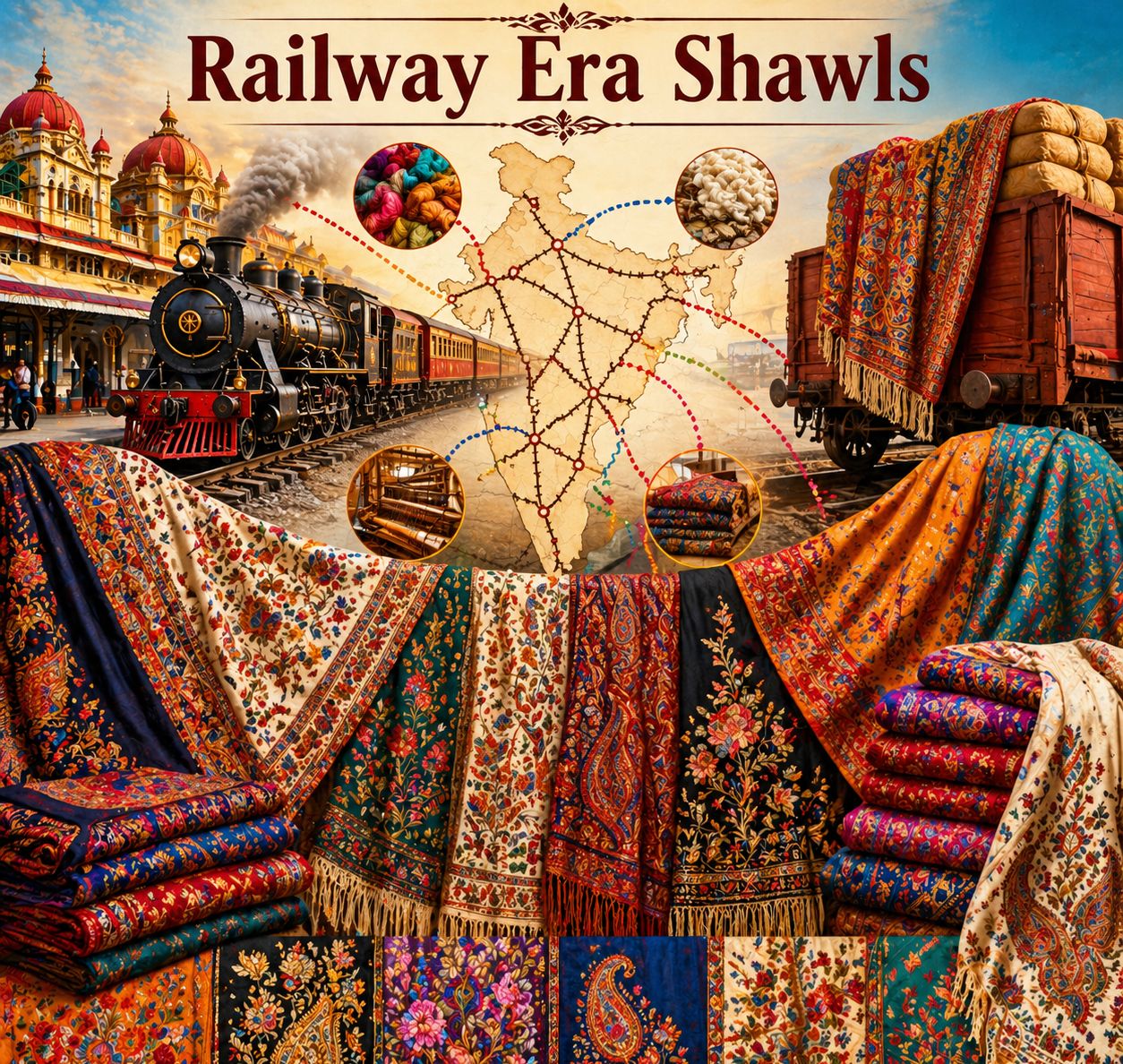
What emerged from this period was not simply decline or replacement, but a distinct category. Railway-era shawls carry visible traces of both worlds. Traditional craftsmanship remains present, yet it is often combined with new materials, evolving aesthetics, and early industrial influence.
Because of this, they do not belong entirely to the past or to modern industry. They sit in between. And it is precisely this in-between quality that makes them compelling to collectors today.
Also Read: A Guide to Pashmina Shawls
Railways, Trade, and the Reshaping of Shawls
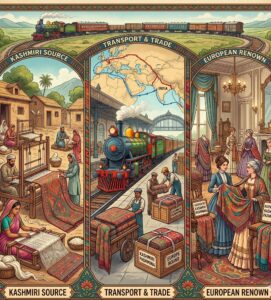
Railways in India were introduced primarily to support colonial trade and administration. Over time, as networks expanded, regions like Kashmir became more connected to major commercial routes.
Because of this, shawls that were once geographically limited began reaching distant markets.
Increased movement created increased exposure. And with exposure came adaptation.
A Parallel Shift in Europe
While Indian antique shawls were entering global markets, a parallel transformation was taking place in Europe. Production centers began to grow, and the town of Paisley became central to this shift.
European manufacturers did not simply admire Kashmiri shawls. They studied them, replicated them, and eventually reinterpreted them. With the introduction of mechanized weaving techniques such as the Jacquard loom, complex patterns could be produced faster and in larger quantities.
Because of this, what had once required time and skill began to be translated into speed and scale.
Railways supported this system at every level. Raw materials such as wool and silk were transported efficiently, while finished goods were distributed across expanding markets. As a result, shawls became more accessible, and demand increased significantly.
Impact of Railways on Trade, Design And Production of Shawls
- From Handcrafted Precision to Scaled Production
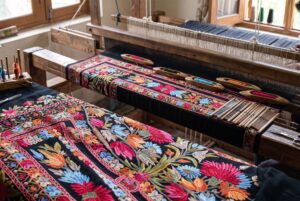
Before industrialization, Kashmiri shawls represented the highest level of textile craftsmanship. Every stage required manual skill, from spinning fine pashmina fibers to weaving intricate designs
Because of this labour-intensive process, production remained limited. Shawls were not widely available, and ownership was restricted to elite circles.
However, as European production expanded, a different model emerged. Shawls began to be produced in larger volumes. While traditional methods continued, they now existed alongside mechanized processes.
This coexistence is key. Railway-era shawls are not purely handmade or purely industrial. Instead, they reflect a moment where both systems overlapped.
- Globalization of Shawls Through Trade Networks
As railway networks expanded across India, previously isolated regions were connected to ports and urban centers. Because of this, Indian shawls could be exported more efficiently.
At the same time, European producers gained access to both raw materials and design inspiration. This created a two-way exchange.
Traditional Kashmiri designs influenced European production, while European manufacturing methods influenced global availability. Therefore, shawls from this period often cannot be understood through a single regional lens.
They are products of movement.
- Design Transformations and Hybrid Aesthetics
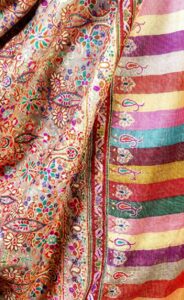
As shawls moved across regions, their designs began to evolve.
Patterns became denser. Empty spaces that were once common in earlier shawls were gradually filled. Motifs were repeated more frequently, and overall compositions became more complex.
At the same time, cross-cultural influences became more visible. Elements from Indian, Persian, and European traditions were combined within single pieces. As a result, railway-era shawls developed a layered visual identity.
This is not simply a variation. It is adaptation in response to new markets and new expectations.
4. The Rise of Printed and Accessible Shawls
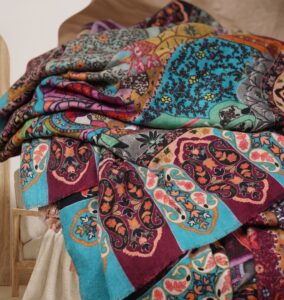
Alongside woven shawls, printed versions began to emerge. These were faster to produce and more affordable.
Printing techniques were developed to imitate traditional weaving. Shading lines, for example, were used to replicate the depth of twill weaves. Because of this, printed shawls could visually resemble more complex textiles.
As a result, shawls became accessible to a broader audience. However, this also introduced a distinction between handcrafted, hybrid, and fully industrial pieces.
For collectors, this distinction remains important.
- Material Innovation and Experimentation
Substitutes for Pashmina
As demand increased, authentic pashmina became difficult to source in large quantities. Therefore, substitutes were introduced, particularly in European production centers.
Silk warps were often combined with wool wefts to achieve similar visual effects at a lower cost. Because of this, railway-era shawls frequently display mixed materials.
Experimentation with Techniques
In addition, printing methods were refined to imitate traditional weaving styles.
Consequently, a wide variety of shawl types emerged, ranging from purely handmade to hybrid and printed forms.
According to studies by the Metropolitan Museum of Art, this period marked a major shift in textile materials and techniques.
- Shawls in the Age of Railway Travel
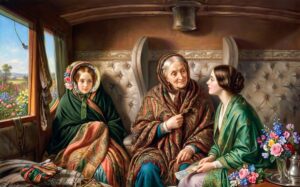
Railways also influenced how shawls were used.
As travel became more common, shawls served practical purposes. They provided warmth during long journeys and protection from dust and soot. Because of this, sturdier wool shawls gained importance alongside decorative ones.
At the same time, fashion trends were influenced by visibility and movement. When Queen Victoria adopted shawls produced in Paisley, their popularity increased significantly.
However, by the late 19th century, fashion began to shift toward more structured garments. Shawls gradually declined in everyday use, although their cultural and collectible value remained.
Why Railway-Era Shawls Matter Today
Railway-era shawls represent a transitional moment that is often overlooked. They are not defined by purity, but by combination.
Traditional craftsmanship is still visible. However, it is layered with new materials, evolving designs, and early industrial influence.
Because of this, these shawls offer something different. They reflect not just where they were made, but how the world around them was changing.
For collectors, this makes them particularly compelling. Each piece carries traces of movement, adaptation, and exchange.
A Category Defined by Movement
The expansion of railways did more than move goods. It reshaped how textiles were produced, distributed, and understood.
Shawls from this period cannot be placed neatly into traditional categories. They belong to a moment when craft and industry overlapped.
Railway-era shawls are defined by this overlap. They are neither fully traditional nor fully modern. Instead, they exist in transition.
And that is precisely what makes them worth collecting.
Giftex: A World of Collectibles Auction
This May, step into a world where history comes alive. Giftex is bringing its A World of Collectibles Auction, featuring antique treasures, vintage collectibles, and rare artefacts. Each piece carries history, craftsmanship, and legacy. Don’t miss the opportunity to discover something truly exceptional.


About Post Author