Manu Parekh: The Artist Who Painted Varanasi Alive
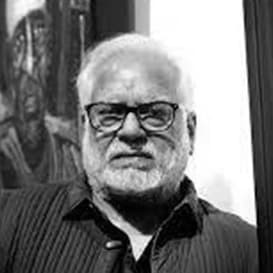
Manu Parekh
Manu Parekh is a distinguished modernist painter known for his series of paintings on the city of Varanasi. Parekh is a prolific painter, and his career over six decades has produced innumerable drawings and paintings.
Perhaps best known for his Banaras series, Parekh’s works are characterised by his intuitive use of colour, bold brushstrokes, and prominent lines.
Stage designer, art designer, actor and artist, Manu Parekh brings diverse perspectives to his work.
His works continue to resonate with collectors, scholars, and art enthusiasts who seek to understand both the artist and the timeless city he brought to life on canvas.
About The Artist
Born in Ahmedabad, Gujarat, Parekh studied at Sheth CN Vidyavihar Fine Arts College, Ahmedabad, before pursuing a diploma in drawing and painting from the JJ School of Art, Mumbai, in 1962. Here, he was introduced to miniature paintings by SB Palsikar, who also mentored him in technical skills. Parekh moved to Kolkata in 1965, then Delhi in 1975, where he began working as a design consultant at the Handicrafts and Handlooms Export Corporation (HHEC).
Influences and Inspirations
Parekh’s work has been influenced by several Indian artists, such as MF Husain, FN Souza, Bhupen Khakhar, Rabindranath Tagore and Ramkinker Baij, as well as Vincent van Gogh, Paul Klee and Pablo Picasso. His art also draws from theatre, folk art, craft, literature and poetry.
A modernist at heart, Parekh’s work drew inspirations from many art movements, including the individualistic styles that gained significance over time.
The Influence Of Theatre
The sense of drama in Manu Parekh’s distinct brushstrokes and expressive portraits stems from his background in theatre. Between the late 1950s and early 1960s, he participated in many inter-college drama competitions, designed sets, and acted in plays.
Exposure To A World Of Traditional Crafts
Manu Parekh joined the Weavers’ Service Centre, an initiative of the All India Handloom Board. He travelled to rural Orissa, Rajasthan, and Haryana, working as an art designer, to document traditional crafts like Ikat and Madhubani. This experience impacted the artist’s early works.
Painting Style & Techniques
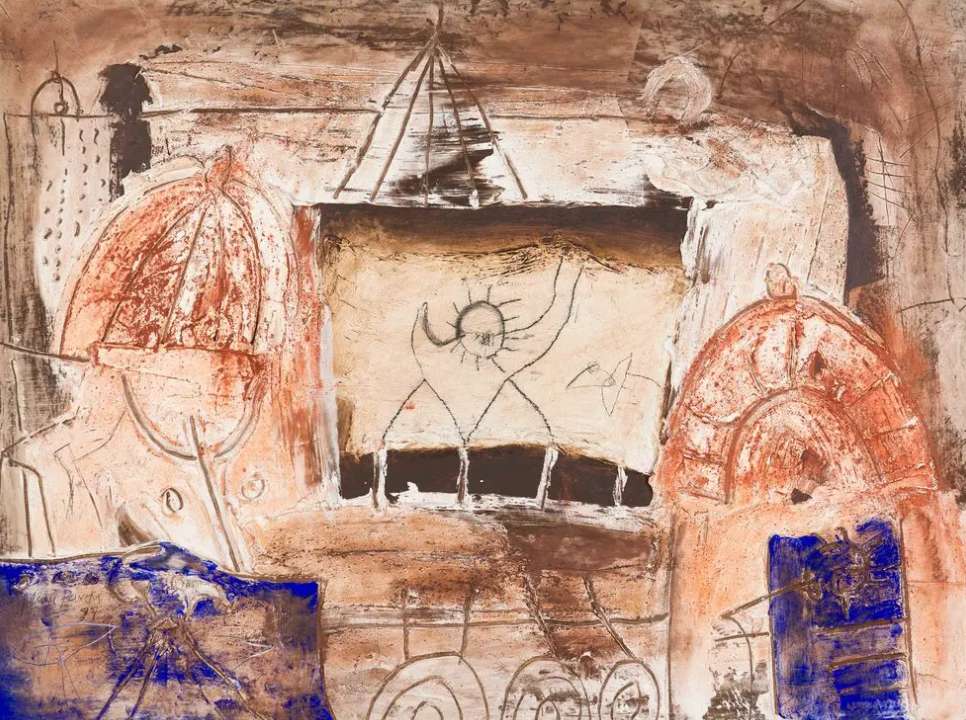
Manu Parekh is known for his use of vivid colours and strong, dynamic brushstrokes. In his early work, Parekh examined the connections between nature and humans because, in his opinion, these connections were vital and should be honoured.
His forms and colours radiate an explosive energy that he is unable to control inside the boundaries of his canvas, and they end up being an extension of his personality. Parekh’s use of vivid colours and strong lines is essential to his artwork since they both convey the intensity that the artist is trying to convey.
The Banaras Series

Manu Parekh Benares
In 1980, Parekh visited Banaras for the first time after his father’s death, and soon after, began painting the ghats of the city, a subject he continued to explore for over three decades, called the Banaras Series.
This holy city of religion, hope, and tourists presented him with a great deal of contrasts all in one place.
In the Banaras series, he has painted the famous ghats brimming with activity, and the temple spires against a vivid backdrop of orange hues of sunsets and cobalt blue skies. The series features depictions of the Banaras ghats observed from a boat on the river, portraying everyday activities such as bathing, praying, sleeping, yoga, and conversations among common people, which evoke a sense of constant motion juxtaposed with profound solitude. Bold, distinct, and dark strokes define the famous Varanasi landscapes and riverscapes. The series gives the audience a walking tour of the city, describing the temples, trees, and boats- elements that largely define the holy city.
Inspiration Behind The Varanasi Series
Parekh’s inspiration for his series stems from his admiration for the mundane activities of the people of Banaras. He incorporated their daily activities in his paintings. He was profoundly interested in the buildings of the city of Lights, Banaras, and also the changing lights and colours of the sky which get reflected in the river.
The artist has also made a black-and-white landscape of Banaras since the city has been imagined by most artists to be saturated with colours. He has incorporated his love of miniature paintings into his paintings along the road.
Symbols and Motifs: Rural India as a Cultural Archive
Manu Parekh’s paintings feature symbols that originate from Indian village life. A single tree a goat, a mud house, a plough, a string of marigolds shows up again and again, yet they look the way they might appear in a dream; brighter, flatter, starker, stripped of every extra detail.
Even in the Banaras paintings, which look city-bound and holy, the village past shows through.
For Parekh, the sacred is not a theory, it grows out of the day-to-day life of people who carry firewood, wash clothes and row boats. That is why the Banaras pictures breathe as well as feel human.
Life, Death, and Spirituality
One of the most compelling aspects of Manu Parekh’s art is his engagement with the themes of life and death.
Varanasi is renowned as a city where death is not hidden but openly acknowledged as part of life’s journey. Funeral pyres burn along the ghats, while nearby worshippers offer prayers and celebrate festivals. This juxtaposition fascinated Parekh and became central to his artistic vision.
Themes and Style
Manu Parekh’s acclaimed Banaras Series is a deeply philosophical and expressionistic exploration of Varanasi.
1. The Dualities of Existence – Parekh’s primary focus is the resolution of contradictions. He captures a city where birth, death, devotion, and decay coexist side by side on teeming ghats.
2. Faith and Flowers – The artist famously noted that the city is defined by “two things… faith and flowers”. Flowers of worship are prominently featured often towering over the landscape which symbolize both reverence and impending decay.
3. Continuous Energy – Rather than focusing purely on religious serenity, Parekh portrays the city as a bustling, miniature universe. The movement of boats, the hum of mundane activities, and the architecture of temples are recurring motifs.
4. Evolution of Form – Early works in the series featured geometric structures rooted in vernacular Indian forms and Pahari miniatures. Over time, his style evolved into more abstract, sweeping, and emotionally intense compositions.
5. Core Techniques and Motifs – Manu Parekh’s artistic practice is distinguished by his intuitive application of vibrant, contrasting colours, such as deep reds, yellows, blues, and oranges, which serve to evoke profound emotional responses and capture the spiritual intensity of his Banaras series.
Final Thoughts
Manu Parekh’s contributions to Indian modernism lie in his innovative synthesis of folk traditions with abstract modernist forms, creating a visual language that revitalized post-independence Indian art.
His ability to blend traditional motifs with contemporary techniques has made his Manu Parekh artwork not only visually striking but also deeply meaningful.
In a time when everything shifts fast, Manu Parekh keeps the village close. His paintings show the feeling and the customs of rural India; the parts city stories skip. He uses present day methods so the memories stay fresh.
As one of India’s most celebrated contemporary artists, Manu Parekh remains the artist who painted Varanasi alive, ensuring that its spirit continues to resonate through generations of viewers and collectors alike.


About Post Author