The Ecological Imagination of Jayashree Chakravarty in Contemporary Indian Art
As environmental concerns become increasingly urgent across the globe, contemporary artists are finding new ways to engage with themes of ecology, sustainability, and humanity’s relationship with nature. Among India’s most significant voices in this discourse is Jayashree Chakravarty, an artist whose practice has consistently explored the fragile balance between the natural world and rapid urban development.
Jayashree Chakravarty is drawn to lines that she perceives in nature, where everything appears webbed and connected. From roots to stems, from textures to twigs to creepers, the continuity of linear patterns and their formations has always fascinated the artist.
Jayashree keenly observes how the change of seasons leaves its marks and traces on the surface of the terrain, how the jagged lines of the barren trees in fall stand out, and the windstorm and pouring rain create their own imprints on the face of the earth.
Over the last three decades, Jayashree’s art practice has addressed the exigent condition of shrinking natural habitat and water bodies in Indian cities.
Jayashree Chakravarty returns to nature to create her monumental works that conjure up, in as simple a manner as possible, a green glade sheltered from human degradation.
In contemporary Indian art, Jayashree Chakravarty’s ecological imagination stands as a powerful reminder of humanity’s responsibility toward nature and the urgent need to preserve threatened environments.
Also Read: Paresh Maity’s Public Art: Why It Resonates
About The Artist
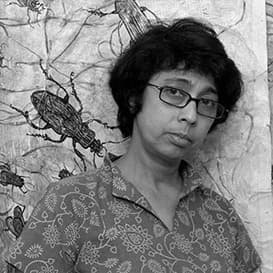
Jayashree Chakravarty is a Kolkata-based Indian visual artist working with the mediums of painting and large-scale installations of paper with mixed media. Rooted in the themes of ecology and nature, and inventing her own creative techniques, she uses organic materials and varied kinds of papers, resulting in installations in the form of paper scrolls that remain unique in both conception and execution.
Born in 1956 in Khoai, Tripura, Jayashree spent her childhood in Agartala, surrounded by lush landscapes and rich biodiversity.
Chakravarty completed her BFA from Visva Bharati University in Santiniketan and obtained her Master’s (diploma) from M. S. University in Baroda. Along with her formal studies in India, she was an artist in residence at the École d´Art in Aix-en-Provence, France.
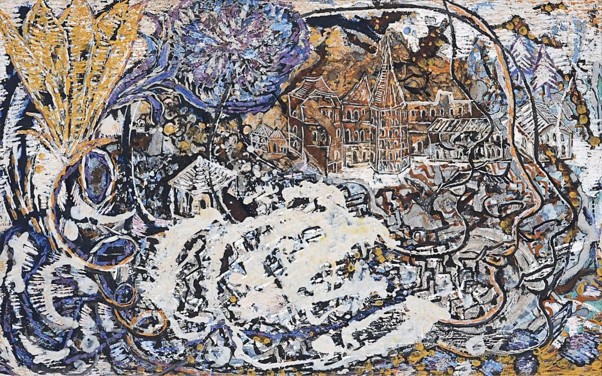
Her art frequently incorporates mixed media, layering organic materials such as leaves, twigs, rice paper, tissue, and cellophane with inks, pigments, and stains. This unique visual language evokes chaotic, dream-like landscapes that reflect both internal memories and external ecological concerns.
Nature as Memory and Experience
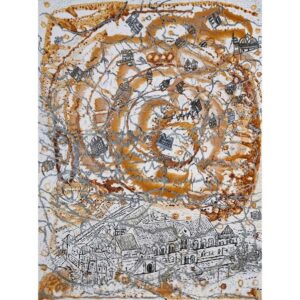
Jayashree’s love for nature is something that she has always celebrated through the works that she builds upon.
Nature is not merely a subject in Chakravarty’s work—it is both the medium and the message. Her art emerges from close observation of natural processes and a profound awareness of environmental transformation. Her works draw sustenance from the organic materials she puts to use, collecting dry leaves and dry flowers, twigs and delicate branches, roots and medicinal seeds, and now, crushed eggshells as well, weaving and mending
Jayashree Chakravarty’s Ecological Imagination in Art
Jayashree Chakravarty’s ecological imagination in contemporary Indian art bridges the gap between memory and the rapid urbanisation of nature. Through massive, layered paper scrolls and installations, she visualises the struggle of nature against concrete expansion, using organic materials to represent Earth’s precarious edge.
Her ecological focus is defined by several key elements:
- Childhood vs. Urbanisation
A defining aspect of Jayashree Chakravarty’s ecological imagination is the contrast between the natural abundance of her childhood and the environmental challenges of modern urban life.
Raised in the lush landscapes of Tripura, her environmental awareness was shaped early on. Moving to the highly urbanised suburb of Salt Lake in Kolkata exposed her to the destruction of marshlands and fisheries, deeply fuelling her artistic anxieties regarding the “concrete jungle”.
This tension between memory and modernity lies at the heart of many of her installations. Her artworks often evoke lush, imaginary ecosystems while simultaneously suggesting their vulnerability.
- Organic Materials
One of the most distinctive aspects of Chakravarty’s practice is her use of organic materials. Rather than relying solely on conventional paints and canvases, she incorporates elements collected from nature into her artworks.
Chakravarty embeds dry leaves, twigs, roots, seeds, and medicinal plants into massive, multi-layered, and translucent paper scrolls. Using materials like mud washes, tea stains, and even repurposed audio cassette tapes, she creates textured, web-like ecologies.
These materials are not decorative additions. They become active participants in the artwork, carrying traces of natural histories and ecological processes.
The resulting surfaces resemble living ecosystems.
- Regeneration and Vulnerability
Her work highlights a “wired ecology”—the interconnected, webbed nature of all living things—while addressing the pain of human encroachment. Her backlit installations often give organic materials an amber-like, glowing appearance, symbolizing both nature’s fragility and its resilient, regenerative potential.
Monumental Installations and Immersive Environments
While Chakravarty is celebrated for her paintings, she is equally renowned for her large-scale installations that transform exhibition spaces into immersive ecological environments.
Many of these works take the form of massive paper scrolls suspended from ceilings or spread across walls. Constructed through labour-intensive layering processes, they resemble forests, underwater ecosystems, geological formations, or microscopic life forms.
Some installations incorporate translucent materials illuminated from behind, creating glowing surfaces that resemble preserved specimens suspended in amber. These luminous structures evoke both fragility and resilience, suggesting ecosystems that endure despite continuous threats.
Her monumental cocoon-like installations further expand this exploration. These structures encourage viewers to enter unfamiliar environments where human dominance is diminished. By shifting perspectives, Chakravarty invites audiences to imagine the world through the eyes of insects, plants, or other non-human life forms.
Santiniketan and Its Influence
The influence of Santiniketan remains visible throughout Chakravarty’s artistic practice. Founded by Rabindranath Tagore, Santiniketan emphasized learning through direct engagement with nature and encouraged artists to develop a holistic understanding of their environment.
This philosophy deeply informed Chakravarty’s approach to art-making. The intricate details, organic rhythms, and ecological sensitivity found in works such as Under the Canopy of Love reflect an enduring connection to Santiniketan’s artistic traditions.
Regeneration, Coexistence, and Hope
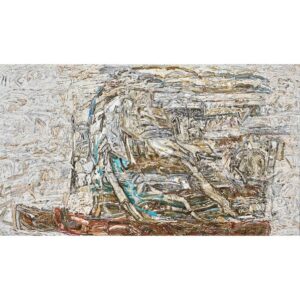
Although environmental anxiety runs throughout her work, Chakravarty’s art is ultimately not pessimistic. Alongside themes of loss and vulnerability, she continually explores regeneration, resilience, and coexistence.
Nature in her works is never static. Even damaged ecosystems appear capable of renewal. New growth emerges from decay, suggesting the possibility of recovery and adaptation.
Her work reminds viewers that environmental sustainability requires not only conservation but also a fundamental shift in how humanity perceives its place within the natural world.
Final Thoughts
Jayashree Chakravarty’s ecological imagination occupies a unique position within contemporary Indian art. Through paintings, scrolls, and monumental installations, she transforms environmental concerns into powerful visual experiences that resonate across cultures and generations.
Drawing from childhood memories, ecological observation, and innovative material experimentation, she creates works that function as both warnings and celebrations. They document disappearing landscapes while envisioning possibilities for renewal and coexistence.
Her intricate networks of roots, branches, and organic forms reveal a world connected by fragile yet enduring relationships—relationships that demand care, attention, and preservation for future generations.
Giftex: Modern Indian Art Auction
This June, Giftex returns with its highly anticipated Modern Indian Art Auction, bringing together a carefully curated collection of modern and contemporary artworks by some of India’s most celebrated masters. Featuring exceptional paintings, sculptures, and rare works, the auction offers collectors and art enthusiasts a unique opportunity to acquire pieces that reflect the richness, diversity, and enduring legacy of Indian art.


About Post Author