Sakti Burman: The Indian Surrealist Who Conquered Paris
A contemporary Indian artist, painter, sculptor and lithographer, Sakti Burman fills his art with mythology and fantasy-inspired images, filled with rich colours.
Born in 1935 in Kolkata, Burman is a celebrated contemporary Indian artist who seamlessly bridges the mythic imagination of the East with the classical traditions of Europe. Based in Paris for decades, he is renowned for his dream-like surrealism, signature marbling technique, and fresco-like textures.
What makes Sakti Burman particularly remarkable is his ability to maintain a strong connection to his Indian roots while becoming a respected figure in the Parisian art scene. This dual identity has enabled him to create art that feels simultaneously familiar and fantastical, traditional and contemporary.
Also Read: The Intricate World of K Laxma Goud’s Artworks
About the Artist
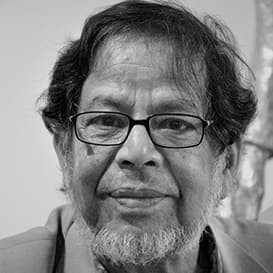
Born in 1935 in Kolkata, India, his childhood and younger days were filled with love, but later, he lived through acute loneliness, with the death of his mother.
Sakti, along with his family, moved to Dibrugarh in 1943, where his father shifted the garments and leather trade and where he and his brothers attended school.
The initial visual examples that drew him towards art were when he glimpsed the painted backdrops of the stage productions his family participated in, and later, when a foreigner showed him a small landscape he wanted framed.
In 1951, Sakti joined a five-year course in fine arts at the Government College of Art & Craft in Kolkata.
With his talent, hard work, and ambition, he was admitted to the Ecole Nationale Supérieure des Beaux-Arts, Paris, where, in 1956, he won the Prix des Étrangers. The Prix des Étrangers (Foreigners’ Prize) is a prestigious award historically offered by the École Nationale Supérieure des Beaux-Arts de Paris (the official French national school of fine arts).
Art Style and Effects
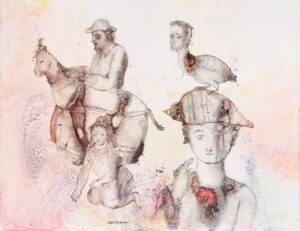
- Signature Marbling Effect
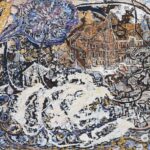
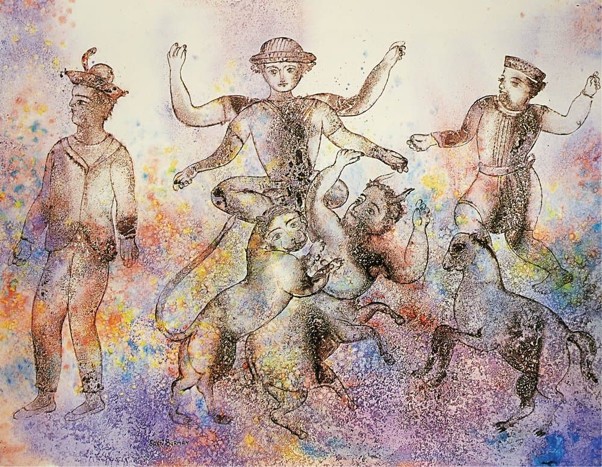
Burman’s most defining trait is a filigreed, speckled marbling texture. He discovered this by “good accident” in his Paris studio when water or turpentine spilt onto an oil canvas, creating a delicate dispersion of veins. He has spent decades painstakingly replicating and perfecting this cracked, mineral-like foundation.
- Pointillism & Stippling
Over his marbled backgrounds, Burman layers his figures using a fine pointillist touch. He applies paint in tiny dots, dabs, and gentle strokes to build up the forms of his characters, giving them a shimmering, luminous quality.
- Printmaking Innovation
He extended his difficult marbling aesthetic into lithographs and prints. This laborious technical process on metal, wood, or stone was achieved by collaborating closely with master printmakers in Paris (the same artisans who worked with Pablo Picasso and Marc Chagall)
Themes
- Italian Renaissance Murals
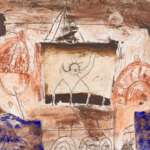
A transformative 1958 trip to Italy deeply influenced him. The grand, weathered frescoes of Giotto, Piero della Francesca, and Simone Martini inspired the monumentality, texture, and muted color palettes seen in his backdrops.
- Indian Heritage
India continues to inhabit his work in the form of characters and episodes from mythology or popular culture, often alluding to Ajanta cave paintings. Birds, animals, dream imagery, and mythological figures such as Shiva’s son Kartikeya, who is referenced as the peacock-riding man, frequently appear, making his work seem surrealist.
- Dual Mythologies
His imagery acts as a cultural crossroads. He effortlessly places characters from Hindu mythology (like Goddess Durga, Shiva, and Ganesha) alongside figures from Greek, Biblical, and European folklore.
- Personal Fantasia
Burman weaves his own family members, including his grandchildren, into dreamlike theatrical scenes. They interact seamlessly with medieval jesters, circus performers, birds, and mythical beasts.
- Surrealism
Burman’s paintings often evoke a surrealist feel, referencing multiplicities of time and place. His art drew extensively from Hindu and European mythology, as well as from the artist’s own memories.
The Making of an Indian Surrealist
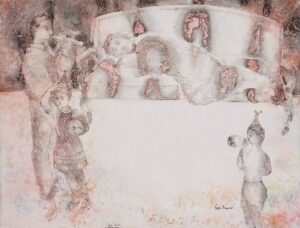
Although Sakti Burman’s work is frequently associated with Surrealism, his interpretation of the movement differs significantly from that of European Surrealists such as Salvador Dalí or René Magritte.
Traditional European Surrealism often explored dreams, psychology, and the unconscious through unsettling or irrational imagery. Burman, by contrast, approaches surrealism through memory, mythology, and poetic imagination.
His dream worlds are rarely disturbing. Instead, they possess a sense of wonder and enchantment.
His paintings blur the boundaries between past and present, dream and memory, mythology and everyday life.
The Paris Connection
No discussion of Sakti Burman is complete without examining his relationship with Paris.
After arriving in France in the mid-1950s, Burman found himself immersed in one of the world’s most vibrant artistic environments. Paris had long been a centre for artistic innovation, attracting painters, writers, and intellectuals from around the globe.
As a young man, Burman no doubt also felt free in his Parisian environment to experiment across art forms and continents, unfettered by cultural or academic definitions. Inspired by Van Gogh and the leading artists of Europe, Sakti wanted to dedicate his life to art the way they had done.
Sakti had initially come to Paris for three years but had stayed long beyond that and the Piccadilly Gallery commission had given him some money – not enough to make him affluent but sufficient to make him comfortable.
The city exposed him to a wide range of artistic influences, including Renaissance art, Impressionism, Symbolism, and Modernism. Museums, galleries, and architectural landmarks provided endless opportunities for study and inspiration.
However, rather than abandoning his Indian heritage, Burman integrated these European influences into his existing cultural framework.
The result was a uniquely hybrid artistic language.
How Paris Influenced His Artistic Vision
Living in Paris fundamentally expanded Burman’s understanding of artistic possibilities.
Exposure to European masters encouraged him to experiment with texture, composition, and narrative structure. The city’s rich artistic heritage also reinforced his interest in storytelling through images.
Furthermore, Paris offered a cosmopolitan environment where diverse cultural influences could coexist. This atmosphere resonated deeply with Burman’s own desire to bridge multiple worlds.
His paintings gradually evolved into spaces where East and West meet harmoniously. Indian gods share pictorial space with European-inspired architectural settings, while mythical narratives unfold through techniques influenced by Western art history.
This cultural fusion became one of his greatest strengths.
Why Sakti Burman Became Popular in Paris
Sakti Burman’s success in Paris can be attributed to several factors.
Firstly, his work offered something genuinely distinctive. At a time when many artists were pursuing abstraction or conceptual approaches, Burman remained committed to narrative painting and figurative imagery.
Secondly, his fusion of Indian mythology with European artistic traditions appealed to international audiences seeking new cultural perspectives. French collectors and critics were particularly drawn to the poetic quality of his paintings.
Finally, his technical mastery and refined craftsmanship earned widespread respect within artistic circles. His paintings demonstrated that narrative art could remain relevant and innovative in the contemporary era.
Final Thoughts
Sakti Burman’s artistic journey is a remarkable story of cultural synthesis, imagination, and enduring creativity. As an Indian artist who built an international career in Paris, he demonstrated that artistic identity need not be confined by geography.
Through his distinctive brand of surrealism, Burman transformed mythology, memory, and fantasy into poetic visual experiences that continue to captivate audiences worldwide. His paintings offer viewers an escape into dreamlike worlds while simultaneously encouraging reflection on history, culture, and personal memory.
More than simply conquering Paris, Sakti Burman created a bridge between India and Europe, proving that art has the power to transcend borders while remaining deeply rooted in one’s heritage.
Giftex: Modern Indian Art Auction
This June, Giftex returns with its Modern Indian Art Auction. Discover masterpieces by celebrated modern and contemporary Indian masters whose visionary works have left a lasting impact on the Indian art landscape.


About Post Author