The Folk Art Legacy in Arpana Caur’s Paintings
One of India’s greatest contemporary artists, with works in museums all over the world, Arpana Caur creates a canvas that inhabits the world of a woman.
Arpana Caur is an eminent Indian contemporary painter and graphic artist, with her career spanning over four decades
She is one of India’s pre-eminent visual artists. Born in Delhi in 1954, she has been exhibiting her art since 1974 and has held shows in all major Indian cities as well as in London, Glasgow, Berlin, Amsterdam, Singapore, Munich, and New York.
Caur’s works encompass paintings with watercolour, gauche and sculptures that are layered with motifs, myths and stories that the artist purposefully references.
Her paintings are not just images, they’re layered narratives of womanhood, social justice, time, spirituality, and trauma.
While her artistic journey is marked by numerous significant series and exhibitions, one of the most remarkable chapters of her career lies in her collaborations with Warli and Godna folk artists.
This blog explores her artistic journey with a focus on her collaborations with Warli & Godna Folk Artists and their lasting impact.
Early Life and Artistic Beginnings
Born in Delhi in 1954, Arpana Caur grew up in an environment rich with literature, music, and creativity. She learnt the Sitar, wrote poetry, but enjoyed painting the most. At the age of nine, she made her first oil painting, ‘Mother & Daughter’ inspired by the works of Amrita Shergil.
Arpana graduated from the University of Delhi with a Master of Arts degree in literature. She never received formal training in painting and was largely self-taught, making her one of India’s most accomplished self-taught artists. She proceeded to receive training in the etching technique at the Garhi Studios in New Delhi, completing it in 1982.
Influences and style

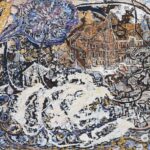
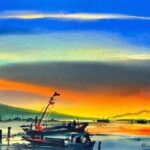
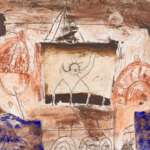
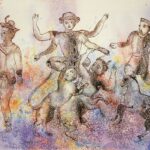
Arpana Caur Folk Painting
Arpana Caur’s paintings were shaped by the events and situations around her. Her mother’s strong influence on her extended into her works, where the ‘woman’ often occupies a central focus.
As a result, women frequently occupy the centre of her compositions, serving as witnesses, survivors, and storytellers. Her works are also inspired by Pahari miniatures (hill-paintings), Punjabi literature, and Indian folk art.
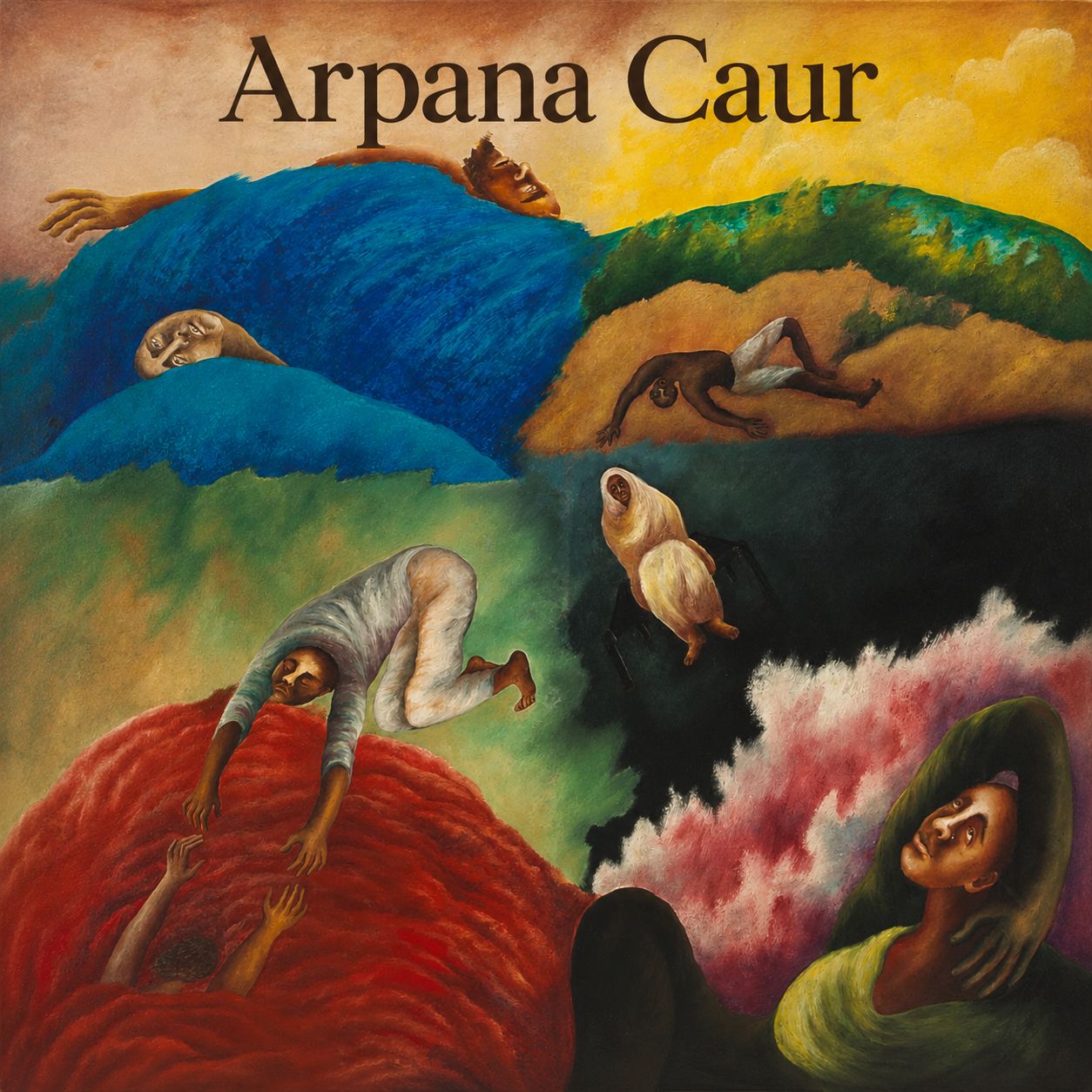
Themes of spirituality, mortality, memory, life, death and time recur throughout her work. Her paintings often present dreamlike landscapes populated by floating figures, flowing rivers, and symbolic objects that invite multiple interpretations.
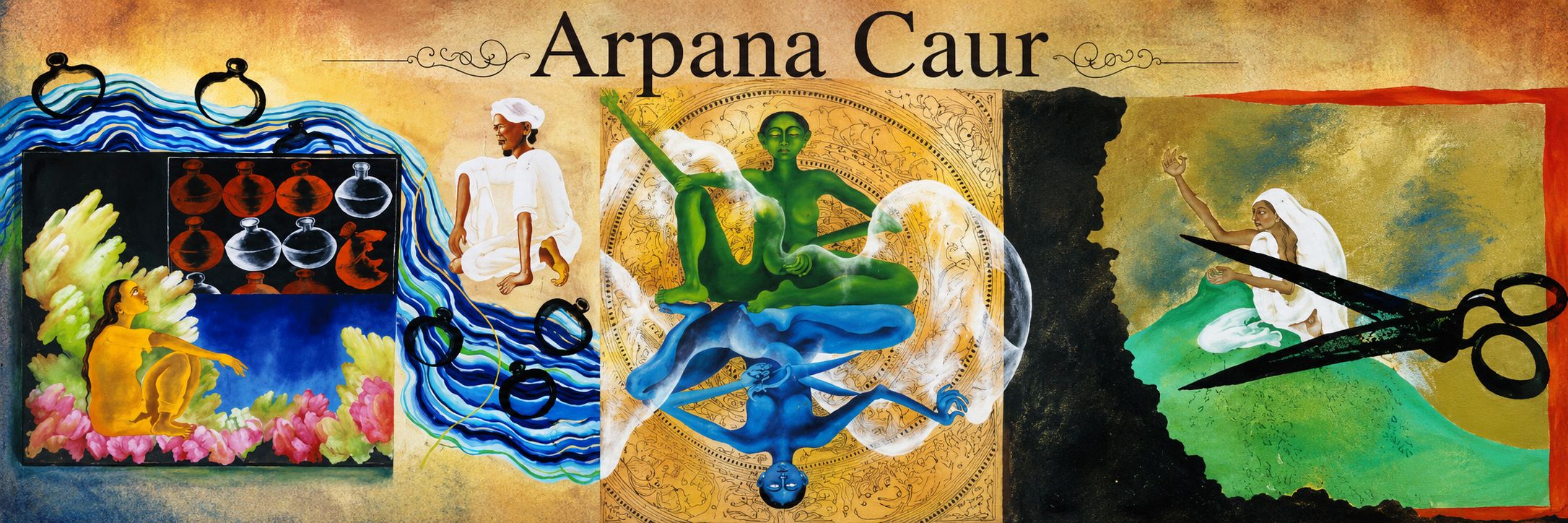
Drawing from miniature painting, Pahari art, Madhubani, and Punjabi folk traditions, her motifs like the iconic scissors; challenge power, cut through illusion, and weave personal with political.
Recurring motifs in her paintings include scissors (symbolizing division and violence) which have earned her the pet name “kainchi”, flowing water (representing time and purification), and floating figures.
Famous Works
- Her famous ‘thread of life’ series about the passage of time, with the scissor as a recurring metaphorical motif. Threads become metaphors for human existence, while scissors represent forces that interrupt or reshape life’s journey.
- Spiritual figures also occupy an important place in her oeuvre. Her paintings depicting Guru Nanak, Buddha, and Kabir reflect a lifelong engagement with philosophical and spiritual traditions. Kabir weaves a fabric that unfurls from the loom in the form of a river. Graceful figures, usually female flow against vast oil canvases filled with bold yellows, reds, blacks and mystical blue
- Her ‘Threat’ series portrays armed authority figures aiming weapons at vulnerable women, creating powerful commentaries on violence and power structures.
- Women again are the subject of the series on the ‘Widows of Vrindavan’, in which we get serial images influenced by Pahari miniatures. These works examine loneliness, social exclusion, and resilience through imagery influenced by Pahari miniatures.
Modern Miniatures
Arpana Caur occupies a unique position in Indian contemporary art because of her ability to reinterpret historical artistic traditions for modern audiences.
Caur brings forward the miniature tradition and is the only contemporary artist who has been creating modern imagery of characters with miniature formats entwined.
Collaborations with Warli & Godna Folk Artists
In the 1990s, Caur created a series of collaborations with Indian folk artists from the indigenous ethnic groups of Warli, from Maharashtra and Godna, who lived in the Madhubani region of Bihar. This partnership yielded a distinct blend of modern, socio-political narrative art fused with centuries-old rural Indian motifs.
She remains one of the first contemporary artists to have collaborated with folk artisans.
The Philosophy Behind The Collaboration
Caur sought to acknowledge the immense cultural contributions of marginalized village communities. To achieve this, she invited ethnic practitioners from the Warli (Maharashtra) and Godna (Bihar) traditions to collaborate with her. By working directly with Warli and Godna artists, she challenged the hierarchy that often separated “fine art” from “folk art.”
Themes
The paintings juxtaposed urban chaos and the destruction of nature (a common concern in Caur’s work) with tribal motifs of harvest, folk dance, and fertility.
Prominent Works
- Rites of Time (2002):
A masterwork featuring embroiderers wielding threads and scissors. Caur incorporated Warli figures representing the eternal dance of life (prakriti) into the canvas, contrasting the organic flow of nature with man’s destruction of the environment.
- Embroiderers (1999):
A painting depicting women in quietude, utilising the tools of their existence. Caur specifically employed Godna folk motifs and a neon-toned palette to highlight the narrative of women spinning and controlling their own destinies.
Impact of the Collaboration
- Bridging “Two Indias”: Caur’s collaborations were a direct protest against an increasingly Westernized and urbanized art market that ignored traditional indigenous artists.
- Stylistic Fusion: She beautifully married the flat perspectives, vivid colours, and sweeping geometry of miniatures and folk art with her own psychological, contemporary figurative style.
- Preservation of Grassroots Tradition: The art bridged the gap between urban consumerist society and remote rural communities, giving mainstream visibility to marginalized folk painter.
- Institutional Recognition: Many of these collaborative and folk-inspired pieces are highly regarded and housed at the Academy of Fine Arts and Literature in New Delhi, where Caur acts as a founding trustee.
Arpana Caur’s Continuing Legacy
Today, Arpana Caur remains one of India’s most influential contemporary artists. Her work continues to inspire discussions around gender, spirituality, environmental consciousness, and cultural memory.
Her collaborations with Warli and Godna artists stand as particularly important milestones in Indian art history. They demonstrated that contemporary art and folk traditions need not exist in separate spheres; instead, they can enrich one another through mutual respect and creative exchange.
Final Thoughts
Arpana Caur’s collaborations with Warli and Godna folk artists represent far more than stylistic experiments. They embody a vision of art as a democratic and inclusive space where diverse voices, traditions, and histories can coexist.
By weaving together contemporary narratives and indigenous visual languages, Caur created works that speak simultaneously to the local and the universal. Her paintings remind us that tradition is not static but living, evolving, and capable of engaging with the most pressing questions of the modern world.


About Post Author