Why Nalini Malani’s Art Remains Politically Urgent in the 21st Century
Nalini Malani stands as a beacon of artistic innovation and social consciousness in the contemporary Indian art scene.
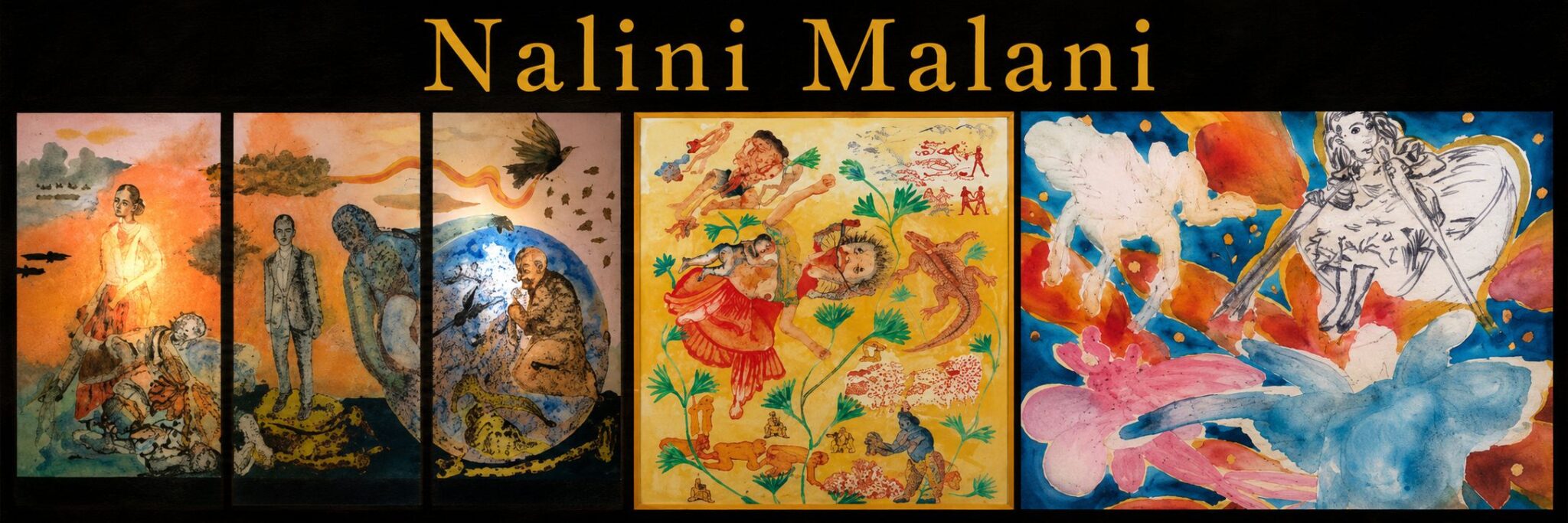
Nalini Malani has spent decades creating works that challenge power structures, question historical narratives, and amplify voices that have long been silenced. Through paintings, films, video installations, shadow plays, and immersive environments, she has consistently used art as a tool for social commentary and political resistance.
In this blog, we explore Nalini Malani’s journey, artistic evolution, major themes, iconic works, and why her art continues to resonate with urgency in the 21st century.
Early Life
Multimedia artist Nalini Malani was born in Karachi in 1946, one year before Partition. Malani’s family had to move from Karachi to Calcutta, and her art practice has been shaped by this early journey. Nalini completed a Diploma in Fine Arts from the Sir J. J. School of Art, Bombay, in 1969. During this period, she had a studio in the Bhulabhai Memorial Institute, Bombay, where artists, musicians, dancers and theatre persons worked individually and collectively. It was here that she had the opportunity to meet and collaborate with artists from allied forms of artistic practice, like theatre. She received a French Government Scholarship for Fine Arts to study in Paris from 1970 to 1972. After graduating, she worked with the experimental Vision Exchange Workshop in Bombay (Mumbai). Her early work included short films such as Still Life and Onanism, which daringly for the time addressed female sexuality.
Artistic Career
Initially, her practice focused on acrylic paintings and watercolours that offered realistic portrayals of contemporary Indian life. However, she continually pushed beyond conventional artistic boundaries, embracing experimental techniques and multimedia approaches.
After her graduation, she spent a few years working with photography and film. The themes she explored during this period dealt with the turbulent time that India was experiencing politically and socially, as well as the deepening literacy of moving image by its population.
One important turning point came when fellow artist Bhupen Khakhar introduced her to reverse painting on acrylic sheets during the late 1980s.
Nalini Malani’s artistic style is characterised by its boldness and diversity, incorporating multimedia techniques such as video installations, shadow play, and hand-drawn animations.
Today, her artistic language combines video projections, shadow play, animation, painting, sound, and installation art, creating immersive environments that engage viewers intellectually and emotionally.
Influences and Themes

Nalini Malani Painting
In the early years of her career, Nalini Malani worked extensively with photography and film, responding to the rapidly changing political and social realities of India
She adheres to the vision of the artist as a social activist. Her artworks are often politically motivated. Throughout the course of her artistic career, she has strived to give voice to the stories of those marginalised by history with a focus on human and universal aspects of conflict and the relationship between the exploiter and the exploited.
Her work often revolves around recurring themes such as feminism, colonialism, violence, and cultural identity. Through her art, Malani challenges conventional narratives and prompts viewers to reconsider social norms and power structures, inviting them into a dialogue about pressing social issues.
One of the distinctive features of Nalini Malani’s work is her use of mythological imagery and symbolism to explore contemporary issues, bridging the gap between the past and the present.
Throughout her career, she has explored themes including:
- Displacement and migration
- War and violence
- Feminism and gender inequality
- Colonialism and postcolonial identity
- Religious extremism
- Consumerism and globalization
- Environmental destruction
- Memory and historical trauma
The Feminist Artist
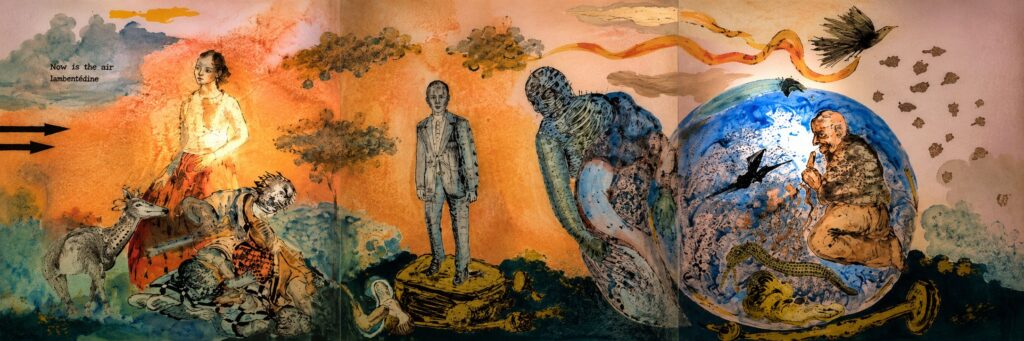
Upon her return from Paris, she settled in the bustling market of Lohar Chawl in Mumbai, where her work reflected the lives of middle-class Indian families. She began working with paintings, acrylic on canvas and watercolour on paper, and produced art that portrayed contemporary India.
After years of negotiation with public and private institutions, she curated the first exhibition of Indian female artists, titled Through The Looking Glass.
Nalini has been an advocate for feminism and has made every attempt to make women visible outside the narratives of femininity through her work. She often gave voice to women who have been silenced by works of literature like Sita from Ramayana and Cassandra and Medea from Greek mythology.
Social and Political Engagement
Beyond the confines of the art world, Nalini Malani is a vocal advocate for social and political change. Her art serves as a platform for raising awareness about pressing issues such as feminism, gender equality, and human rights. Through her activism and engagement with feminist movements, Malani continues to push boundaries and challenge the status quo, inspiring others to join the fight for social justice.
Why Nalini Malani’s Art Remains Politically Urgent Today
Nalini Malani’s art remains politically urgent in the 21st century because it directly confronts the enduring global realities of authoritarianism, religious extremism, and the systemic marginalization of women.
1. The Persistence of State Violence & Militarism
Nalini Malani’s seminal works, such as Gamepieces (2003-2020), were born in direct response to the nuclear arms race. Today, her shadow plays and projections—which superimpose mythical, destructive figures onto silhouettes of mushroom clouds—critique the relentless, cyclical nature of war, nationalism, and the destructive power of the modern state.
2. Radical Feminist Reinterpretations
A pioneer of feminist art in India, Malani actively dismantles patriarchal, state-sanctioned mythologies. In ongoing projects like Stories Retold and the 2026 commission Of Woman Born, she subverts the portrayals of classical figures like Sita and Yashodhara.
3. The Lived Trauma of Partition & Displacement
As a refugee from the 1947 Partition of India—born in Karachi—Malani’s personal history of displacement has profoundly shaped her practice. Her art serves as a perpetual reminder of the dangers of sectarian violence, religious orthodoxy, and communalism, highly relevant as societies across the globe continue to grapple with escalating ethnic tensions and mass migrations.
4. Ecological and Social Catastrophes
Malani’s ethical urgency extends to environmental devastation and corporate impunity. Her multimedia installations draw attention to modern ecological tragedies and corporate-led exploitation, framing human suffering as inextricably linked to reckless development and the pursuit of power.
5. Challenging the Digital Age with “Erasure”
Utilizing avant-garde mediums like multi-channel iPad animation chambers, video/shadow plays, and her signature “Wall Drawing/Erasure Performances,” Malani’s fragmented, stream-of-consciousness aesthetic captures the overwhelming, hyper-mediated experience of the 21st century. She forces viewers to confront the ease with which historical truths can be manipulated or “erased” in the modern information age.
Legacy and influence
As a pioneering contemporary artist, Nalini Malani’s legacy transcends borders and generations. Her work has left an indelible mark on the art world. Her work has been exhibited at leading museums and biennales worldwide, establishing her as one of the most important voices in contemporary global art.
Today, her work continues to inspire artists, curators, scholars, and activists across the world.
Final Thoughts
Nalini Malani’s art remains politically urgent because the issues she addresses have not disappeared. War, displacement, gender inequality, historical erasure, environmental destruction, and authoritarian power continue to shape the modern world.
Through her unique fusion of mythology, history, technology, and activism, Malani compels us to confront uncomfortable truths and reconsider whose voices are heard and whose stories remain untold. More than an artist, she is a witness, a critic, and a storyteller whose work continues to challenge, provoke, and inspire in the 21st century.


About Post Author