G R Iranna: Painting Pain, Power & Spiritual Resistance
Contemporary Indian art is filled with artists who challenge conventions, but few do so with the quiet intensity of G R Iranna.
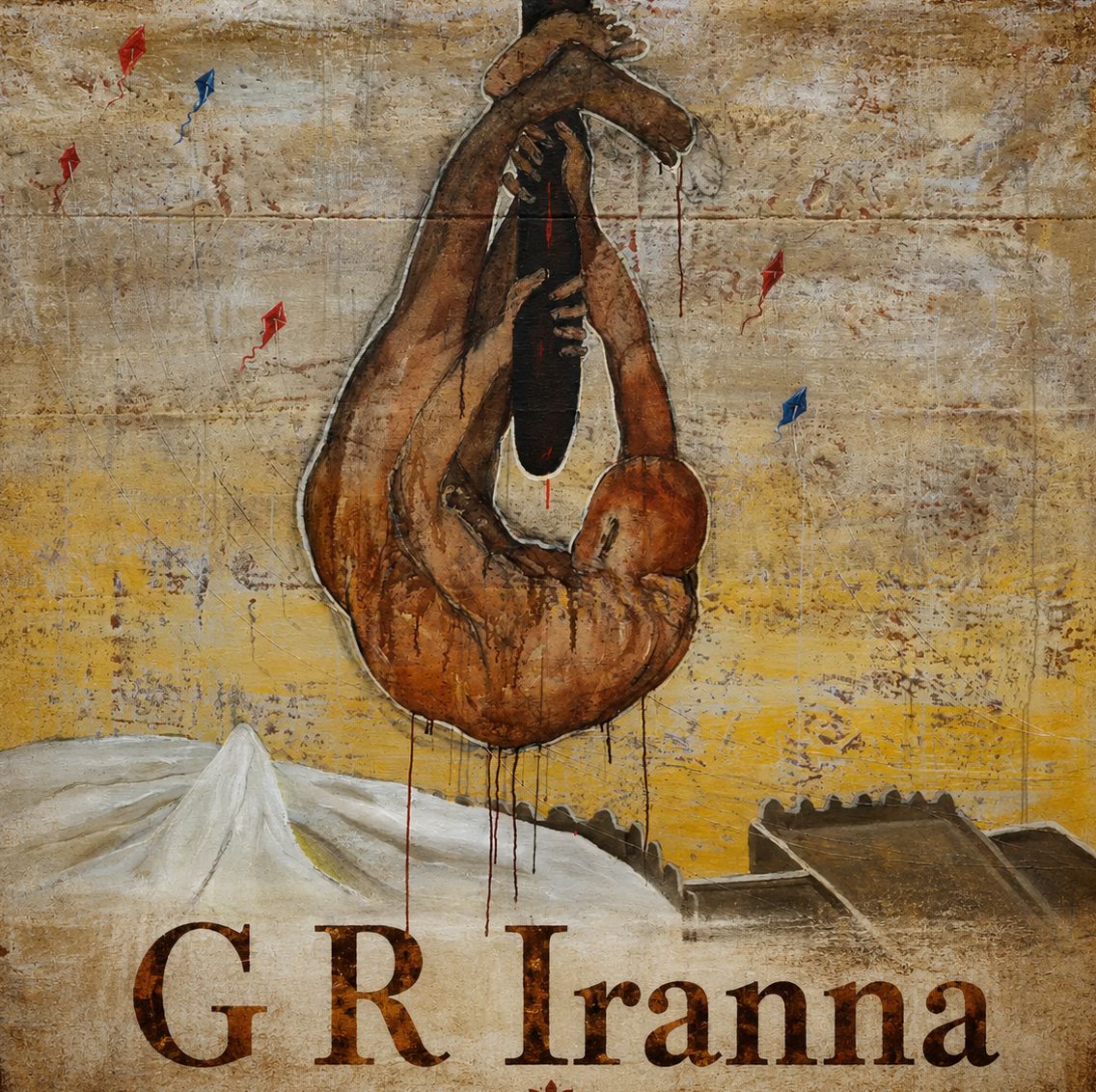
G R Iranna is not just an artist – he is a seeker, a witness, and a storyteller of our time. His work, layered with bruised textures, tormented energies, and evocative silences, bridges the traditional with the contemporary, the personal with the political.
as an artist whose work transcends the boundaries of time and space. The thoughts behind his artworks and installations tell us about the society we live in. Through scarred surfaces, ash-laden textures, and symbolic imagery, Iranna creates a world where pain becomes a source of reflection, power is questioned, and spirituality emerges as a form of resistance.
His paintings and installations invite viewers to confront profound questions about life, death, suffering, and the human condition. In a world increasingly driven by speed and consumption, his art offers a rare space for contemplation.
Also Read About Sakti Burman: The Indian Surrealist
About The Artist
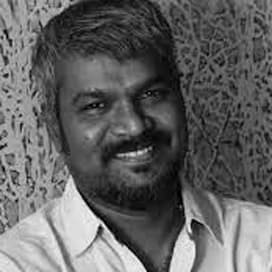
Hailing from rural Karnataka, Iranna’s artistic journey began on the village roads of his childhood, where he sketched Hanuman with chalk on freshly laid-out streets. These innocent gestures, etched in dust and devotion, were the first whispers of a life-long commitment to the visual language of spirit and struggle.
He was raised in the constructive environment of Sarang Math, a traditional ashram school, where he was shaped through meditation, inquiry about the world, discipline and finding oneself in solitude.
Recognizing his passion and talent, his guru encouraged him to pursue art. With this encouragement, G R Iranna went on to get his Master’s from the College of Art, New Delhi.
Another significant event in his life was when he received the Charles Wallace scholarship and studied at Wimbledon School of Art, London – an exposure that significantly expanded the depth and scale of his practice. Today, G R Iranna is recognized as one of India’s leading contemporary artists, exhibiting extensively both nationally and internationally.
The Artistic Language of G R Iranna
What makes G R Iranna’s work instantly recognizable is his unique visual vocabulary. His art exists at the intersection of abstraction and figuration, where forms emerge and dissolve, creating an atmosphere of mystery and contemplation.
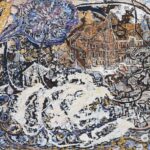
Rather than relying on conventional techniques, Iranna experiments extensively with materials. He often works on unconventional surfaces such as tarpaulin, transforming industrial materials into powerful artistic statements. Layers of acrylic, coal powder, ash, tar, and brick dust create heavily textured surfaces that appear weathered by time.
These materials are not chosen merely for their visual appeal. Each element carries symbolic significance. Ash speaks of destruction and regeneration, tar evokes industrialization and decay, while rough textures suggest the scars left by history, memory, and lived experience.
The resulting works possess an archaeological quality, as though they contain traces of forgotten stories buried beneath the surface.
The Artistic Language of G R Iranna
What makes G R Iranna’s work instantly recognizable is his unique visual vocabulary. His art exists at the intersection of abstraction and figuration, where forms emerge and dissolve, creating an atmosphere of mystery and contemplation.
Rather than relying on conventional techniques, Iranna experiments extensively with materials. He often works on unconventional surfaces such as tarpaulin, transforming industrial materials into powerful artistic statements. Layers of acrylic, coal powder, ash, tar, and brick dust create heavily textured surfaces that appear weathered by time.
These materials are not chosen merely for their visual appeal. Each element carries symbolic significance. Ash speaks of destruction and regeneration, tar evokes industrialization and decay, while rough textures suggest the scars left by history, memory, and lived experience.
The resulting works possess an archaeological quality, as though they contain traces of forgotten stories buried beneath the surface.
Art Style And Themes
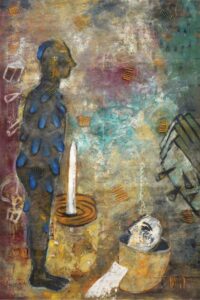
G.R. Iranna is a prominent contemporary Indian artist known for his multi-disciplinary practice that spans paintings, mixed media, and installations. His art explores the philosophical dualities of life, death, nature, and human vulnerability through rich, textural surfaces.
Painting Style
- Quasi-Abstract & Figurative: Iranna blends representational elements (like trees or silhouetted human figures) with abstraction. His work does not aim for literal depiction but rather emphasizes emotional and spiritual resonance.
- Material Experimentation: He is renowned for using unconventional surfaces, most notably tarpaulin, which provides a raw, industrial base.
- Textured Surfaces: Instead of traditional oils, he frequently employs acrylic, ash, coal powder, and brick dust. This creates a “palimpsest-like” surface that feels heavy, textured, and weathered.
Core Themes
His art is marked by meditative abstraction and symbolic imagery that engage with themes of memory, suffering, and transcendence.
- The Tree as Metaphor: Trees are a major recurring motif in his works. Iranna views trees as sentient beings, embodying resilience, tolerance, and the profound connection between humanity and nature. In his Tempered Branches series, he treats trees as metaphors for human beings, using pruned and manipulated branches to reflect the ways individuals are shaped, controlled, and conditioned by external forces.
- Existential Dualities: His works constantly juxtapose opposing forces: permanence and transience, nature and artifice, and the material versus the spiritual.
- The Cycle of Life & Death: Deeply inspired by his early upbringing in rural Karnataka and his immersion in Indian spiritual philosophies (like Sufism, Buddhism, and Lingayatism), he often explores how life reduces to nothingness and regenerates.
Meaning & Philosophy
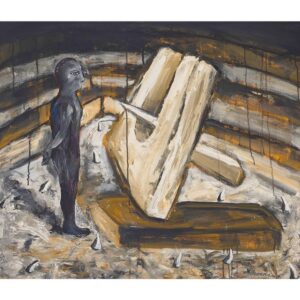
Through works that incorporate tar, cloth, or ash, Iranna reflects on impermanence and the endurance of the human spirit. His practice often resonates with philosophical underpinnings, presenting a poetic dialogue between form and meaning.
- Emptiness and Ash: His fascination with ash is central to his meaning. It is the residual matter of nature—both the origin and the end. To Iranna, ash symbolizes that all forms eventually return to a formless state.
- Social Commentary: While highly meditative, his work also comments on modern society. For instance, his “Tempered Branches” series uses pruned, manipulated trees as a metaphor for the manipulation of the human (and especially a child’s) mind.
- Human Vulnerability: In pieces outside his tree series, he highlights anonymous, often naked human figures to critique systemic violence, oppression, and the loss of dignity in modern life.
Painting Pain, Power & Spiritual Resistance
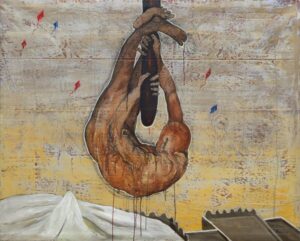
At first glance, G R Iranna’s paintings appear wounded. Their dark surfaces, charred textures, fractured forms, and scarred layers evoke a sense of suffering that is both personal and collective. Yet, these works are not depictions of pain alone. They are meditations on what remains after pain—resilience, endurance, and the possibility of transcendence.
Power is another recurring undercurrent in Iranna’s practice. Through motifs such as pruned trees and anonymous human figures, he reflects on the ways individuals are shaped by social, political, and cultural forces. His works subtly question systems of control, suggesting how identity is often moulded, restricted, or challenged by the world around us.
At the same time, spirituality remains at the heart of his artistic vision. Drawing from the meditative traditions that influenced his upbringing, Iranna views art as a space for introspection and transformation. Materials such as ash become metaphors for impermanence and renewal, reminding viewers that every ending carries the possibility of a new beginning. In this balance between suffering and transcendence lies the essence of his art—a quiet yet powerful form of spiritual resistance.
Why G R Iranna’s Art Matters Today
In an increasingly fragmented world, Iranna’s works encourage viewers to slow down and reflect. His art does not offer straightforward narratives; instead, it creates a contemplative space where questions of identity, mortality, and human resilience can be explored. By bridging personal experience with universal concerns, he has established himself as one of the most thoughtful voices in contemporary Indian art.
Final Thoughts
G R Iranna’s art is a compelling meditation on pain, power, and spiritual resistance. Through textured surfaces, symbolic forms, and philosophical inquiry, he transforms ordinary materials into profound reflections on human existence.
Whether through scarred trees, anonymous figures, or layers of ash, his works remind us of life’s fragility and resilience. They challenge viewers to confront suffering, question systems of control, and seek meaning beyond material realities.
In an era often defined by noise and distraction, G R Iranna’s art stands as a powerful reminder of the importance of reflection, empathy, and inner strength.
Giftex: Modern Indian Art Auction
This June 26–27, Giftex returns with its celebrated Modern Indian Art Auction. Explore a curated collection of masterpieces by renowned modern and contemporary Indian artists whose works have shaped the nation’s artistic legacy and continue to inspire collectors worldwide.


About Post Author