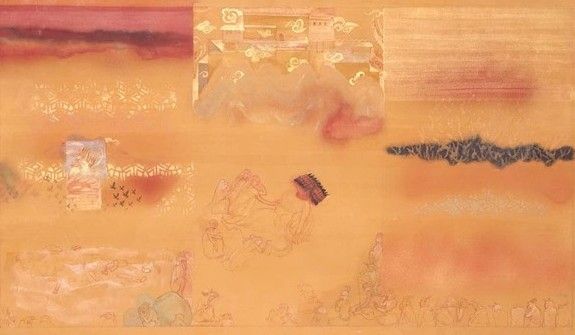
How Literature, Poetry & Oral Traditions Shape Nilima Sheikh’s Paintings
To investigate the form and linguistic calibrations of other loved poetic traditions, and in my case of other visual resources, other loved art histories, has been the project.
—Nilima Sheikh, Artist Statement
Nilima Sheikh (b. 1945, New Delhi) is a luminary in the realm of contemporary Indian art, recognized for her distinctive integration of miniature painting techniques with larger installations. She is known for creating bold, colourful and figurative works.
Her art is rooted in Eastern painting traditions such as miniature painting and oral traditions found in vernacular folk songs. Through her own life experiences, Sheikh continues to create bodies of work that evoke mystical imaginary landscapes that address feminine experiences. Literature and poetry have remained central to this practice, enabling her to explore themes of memory, displacement, identity, gender, ecology, and cultural preservation.
Also Read: Manu Parekh: The Artist Who Painted Varanasi Alive
About The Artist

Nilima was born to doctor parents in 1945 in Delhi. She studied history at the University of Delhi from 1962-65 and went to get her Master’s in Painting from the Faculty of Fine Arts, Baroda, in 1971.
K.G. Subramanyan taught her about the languages of several art-making processes at Baroda. Sheikh, inspired by poetry, folk tunes, and Indian miniature traditions, turned to narrative painting as a way to address contemporary issues. Her training as a historian profoundly shaped her artistic outlook. Unlike many artists who approach history through visual archives alone, Sheikh developed a fascination with how stories are preserved through texts, songs, myths, and oral traditions.
She has often spoken about her early encounters with the writings of Rabindranath Tagore, whose poetry and prose revealed the intimate relationship between words and images. Her works are deeply rooted in the landscapes, cultural traditions, and historical narratives of South Asia, including Kashmir. Drawing inspiration from folklore, poetry, and historical texts, Sheikh’s art invites reflection on themes such as migration, memory, love, and resilience, often interwoven with an acute sensitivity to the natural world.
Art Style
The translation of memory, history, and text into a visual language is at the core of Nilima Sheikh’s artistic endeavours.
Inspired by reading Rabindranath Tagore, the artist became interested at an early age in the connection between stories and images, and the age-old connection from murals to ancient manuscripts. Nilima Sheikh’s work focuses on longing, loss, roots, displacement, violence, the
perception of tradition and ideas of femininity. Her paintings, using tempera on handmade paper or canvas, as well as the formats and modes of installation she employs, are influenced by East Asian, Persian, Central Asian, pre-Renaissance European and North Indian schools of tempera painting.
During the last two decades, she has often been working on subjects that relate to the northern region of the Indian sub-continent, with particular emphasis on Kashmir.
Poetry as a Visual Language
Poetry occupies a special place in Sheikh’s artistic practice. Rather than treating poems as subjects to be illustrated, she approaches them as reservoirs of imagery, rhythm, mood, and metaphor.
Poetry also allows Sheikh to address experiences that are difficult to articulate directly. Themes such as longing, loss, exile, love, and remembrance are often expressed through symbolic imagery rather than explicit narrative. This poetic sensibility enables her works to remain open-ended, inviting viewers to construct their own interpretations.
The Influence of Oral Traditions and Folk Songs
Equally significant to Sheikh’s practice are oral traditions that have been transmitted across generations through songs, storytelling, and performance.
Unlike written literature, oral traditions carry the voices of communities, preserving memories that often remain absent from official historical records. Sheikh has long been interested in these alternative forms of knowledge, particularly vernacular folk songs sung by women.
Many of these songs speak about migration, separation, marriage, longing, labour, and everyday life. They preserve intimate histories that rarely find space in conventional narratives. Sheikh incorporates this emotional and cultural richness into her work, creating paintings that resonate with collective memory.
Literature, Feminism, and Women’s Voices
Throughout her career, Nilima Sheikh has shown a sustained interest in women’s experiences and the ways they are represented—or overlooked—in historical narratives.
Literature and oral traditions provide her with access to female perspectives often excluded from official accounts.
Between 1982 and 1987, N. Sheikh received fellowships from the Government of India to initiate research into the traditional art practices of India, with a focus on the Pichhwai paintings of Nathdwara, Rajasthan. She brought to bear her knowledge of Pichhwai and scroll paintings when designing banners, screens and painted sets for the feminist theatre company Vivadi. These collaborations reinforced her belief in storytelling as a collective and political act.
Kashmir: Art as Documentation and Witness
One of the most important themes in Sheikh’s work over the last two decades has been Kashmir. Here, literature, history, poetry, and documentation converge powerfully.
As someone trained in history, Sheikh became deeply interested in understanding Kashmir beyond political headlines. She immersed herself in historical texts, travel accounts, poems, local narratives, and cultural traditions associated with the region.
For Sheikh, the artist’s role is not merely to record events but to bear witness to human experiences that might otherwise be forgotten. Her paintings often combine fragments of text with visual imagery, creating layered narratives that preserve multiple perspectives.
Miniature Traditions and Storytelling
Sheikh’s engagement with literature is closely tied to her fascination with miniature painting traditions.
Historically, Indian, Persian, and Central Asian miniature paintings often accompanied literary texts. Illustrated manuscripts transformed poems, epics, and historical narratives into visual experiences. Sheikh draws inspiration from this tradition while adapting it for contemporary contexts.
Rather than replicating miniature painting styles, she reinterprets their narrative possibilities. Her paintings frequently feature layered storytelling, flattened perspectives, decorative borders, and detailed landscapes that recall manuscript traditions.
This connection between text and image allows her to create works that operate simultaneously as paintings and visual narratives.
Preservation Through Art
Preservation and documentation are central concerns in Nilima Sheikh’s practice. She became increasingly interested in safeguarding not only visual techniques but also the stories, rituals, songs, and histories associated with them.
Her own artistic methods reflect this commitment to preservation. Working with natural pigments, handmade paper, tempera techniques, and traditional craft practices, she revives historical materials while adapting them to contemporary concerns.
In this sense, her paintings function as repositories of cultural memory.
Final Thoughts
Nilima Sheikh’s art demonstrates the enduring power of storytelling across media. Drawing upon literature, poetry, oral traditions, folklore, and historical documentation, she creates paintings that transcend conventional boundaries between text and image.
Her works are not simply visual objects; they are acts of remembrance, preservation, and witness. Whether inspired by Tagore’s writings, women’s folk songs, miniature manuscripts, or the layered histories of Kashmir, Sheikh transforms narratives into richly textured visual worlds. n doing so, Nilima Sheikh has created a body of work that preserves cultural histories while speaking profoundly to contemporary experiences of identity, belonging, and resilience.
Giftex Modern Indian Art Auction
This June, Giftex returns with its renowned Modern Indian Art Auction. Discover exceptional modern and contemporary masterpieces by eminent Indian artists and sculptors, and bring a legacy of art, culture, and timeless elegance to your space.


About Post Author