How Jitish Kallat uses Numbers, Dates & Archives as Art Tools
Jitish Kallat
A painter, sculptor, photographer, and installation artist, Jitish Kallat explores form—how a mark becomes an idea—and our status in the universe
Kallat uses an array of materials in his artworks, yet they are often linked through language and acts of speech.
Jitish Kallat’s work straddles the intersection of science, historical memory, existential enquiry, and the rhythms of the natural world.
Over the years, Kallat has developed a style that utilises dates, measurements, numbers, and other archival materials, converging the everyday with the cosmic.
What sets Jitish Kallat apart from other contemporary artists is his ability to combine modern technology with traditional artistic techniques, creating multi-layered works that engage viewers intellectually and emotionally.
While some of his works reflect on the transient present, others invoke the past, drawing from historical archives and utterances. His work has been widely exhibited at major museums and institutions worldwide, including the Art Institute of Chicago, Tate Modern, and the Serpentine Galleries.
Early Life
Jitish Kallat was born in Mumbai in 1974, the city where he continues to live and work. Kallat’s earliest memory of art was of helping his elder sister, a five-year-old, with a drawing in her biology book. By the time he was in his mid-teens, he was, in his own words, ‘persistently and obsessively drawing’.
Kallat secured a degree in fine arts in 1996 from the Sir J. J. School of Art.
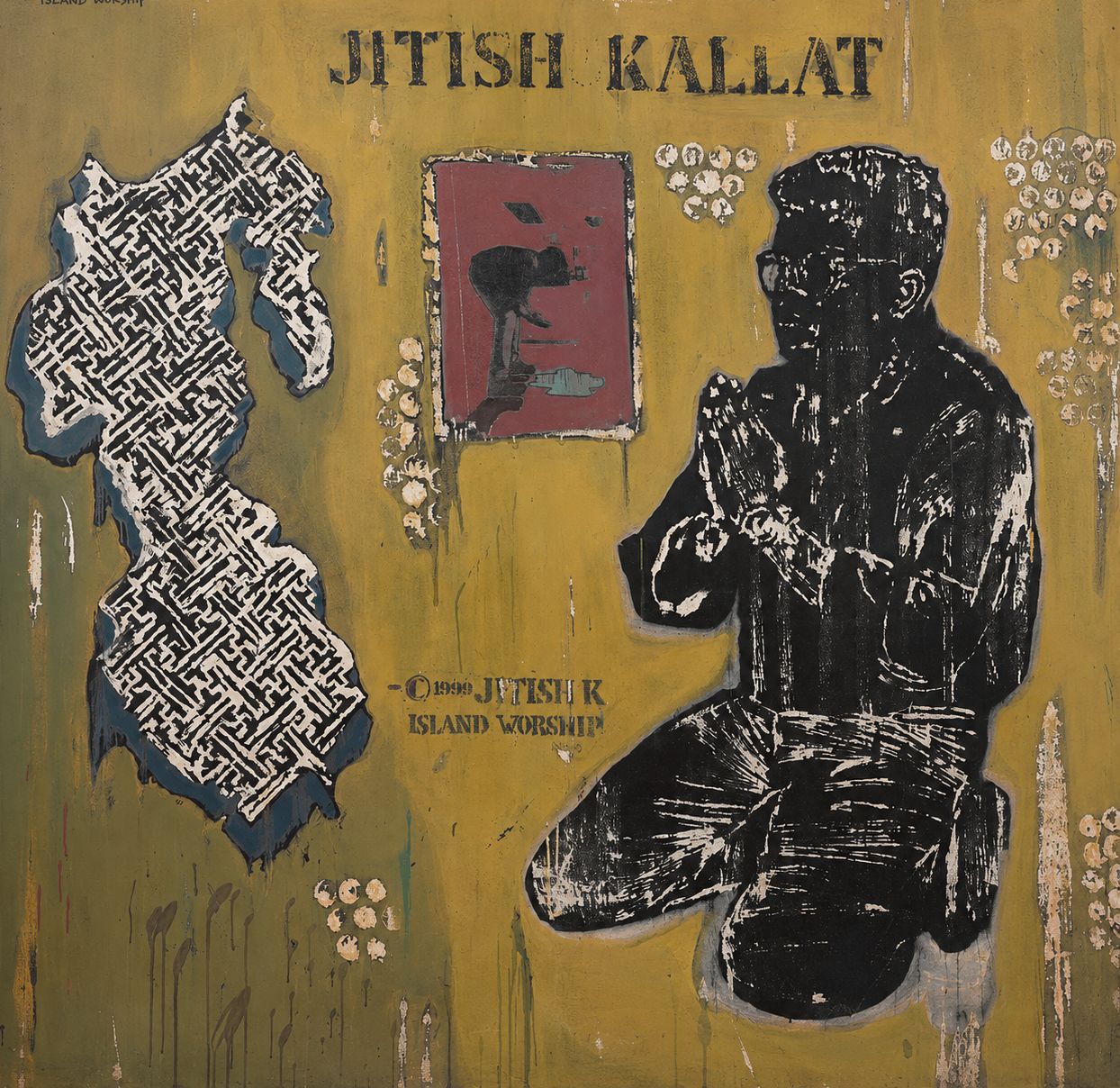
He rejected his training in Modernism and abstraction to create early works based on references to the billboards and popular culture of Mumbai.
Kallat portrays the socio-economic and political circumstances of the city in a way that emphasizes its liveliness and resilience.
Styles and Medium
His work seamlessly shifts between the microscopic and the cosmic to explore human struggle, historical legacy, and the impermanence of life.
- Early Style: Drew heavy inspiration from the chaotic urban streets of Mumbai, incorporating elements of billboards, graffiti, and advertisements to create layered, highly textured canvases.
- Later Style: Moved toward abstract, conceptual, and archive-based works. His methods frequently involve natural processes, mathematical patterns, and scientific phenomena to make the invisible forces of the world visible.
Key Themes
- Time, Memory, and Recursion: Kallat’s art is a deep meditation on the passage of time. He frequently juxtaposes the transient present with deep, cosmological scales, constantly questioning human mortality and cyclical existence.
- The Cosmos: He explores the intersection of dense, highly urbanized environments (like Mumbai) and the vastness of the universe.
- Historical Memory and Dissent: He frequently revives significant historical texts—such as letters and political speeches—to offer meditations on peace, tolerance, and human fragility.
Recurring Symbols and Motifs
- Rotis (Indian Bread): Used in works like The Eternal Gradient and Breath, the progressive eating or molding of a roti serves as a metaphor for the lunar cycle, time passing, hunger, and sustenance.
- Historical Documents: Kallat utilizes famous letters and speeches (such as Mahatma Gandhi’s letters or Jawaharlal Nehru’s addresses) as physical materials in his work to bridge the past and present.
- The Celestial: Maps, constellations, lunar cycles, and astronomical charts act as symbols for deep history, scale, and the interconnectedness of humanity.
Why Numbers Matter in Jitish Kallat’s Art
In Jitish Kallat’s art, numbers serve as philosophical and existential measuring tools that connect the intimate scale of the human body to the vastness of the cosmos. By tracking population, time, and historical data, he visualizes abstract concepts like birth, mortality, and our proximity to global catastrophe.
In many of his works, numerical references become a bridge between personal memory and public history.
The Significance of Dates in His Work
Dates occupy a particularly important place in Kallat’s artistic vocabulary.
Rather than treating dates as isolated historical markers, Kallat uses them as portals through which viewers can revisit significant events. A date in his work is rarely just a reference to the past; it becomes a way of questioning the present. His use of dates creates a dialogue between eras. Events separated by decades suddenly feel immediate, allowing audiences to reconsider history not as something distant but as something continuously unfolding.
Archives as Living Material
In the art of Jitish Kallat, “archives as living material” matter because they transform static historical records into breathing, contemporary meditations on humanity. Kallat merges deep history, everyday urban artifacts, and cosmic time to make the past relevant to the present.
Letters, speeches, photographs, public records, and historical documents frequently appear in his work.
How Jitish Kallat uses Numbers, Dates & Archives as Art Tools
Jitish Kallat uses numbers, dates, and archives as conceptual framing devices to explore the passage of time, planetary consciousness, and human vulnerability.
1. Archives as Sites of Philosophical Inquiry
Kallat frequently mines historical and scientific archives to find profound utterances of humanity, juxtaposing them to reflect on societal failures and resilience.
• Covering Letter (2012): He projected a historic, seven-line plea for peace written by Mahatma Gandhi to Adolf Hitler onto a descending film of mist, creating an illuminated piece of correspondence that visitors can physically traverse.
• Antumbra (2024): He explored Nelson Mandela’s prison diaries (1976–1989), overlaying dates, blood pressure readings, and dream entries with global historical events.
2. Dates as Personal & Cosmic Markers
Kallat uses dates to track historical milestones, celestial cycles, and profound personal timelines.
• Epilogue (2011): An autobiographical work where he re-traced and visualized every single moon phase (and corresponding date) his father saw during his lifetime.
• Public Notice Series: In Public Notice 3, he inscribed Swami Vivekananda’s 9/11/1893 speech (calling for tolerance) across the steps of the Art Institute of Chicago, utilizing the five colours of the U.S. Homeland Security Advisory System to comment on a world threatened by fear.
3. Numbers as Global Attendance Calls
Kallat treats numbers as a way to quantify human existence, recording live demographic algorithms to highlight the fragility and sheer volume of global life.
• Integer Studies / Otherwhile: Throughout the pandemic, he kept a daily drawing log. These works charted the projected world population alongside smaller figures representing births and deaths that took place at that exact hour.
• 22,000 Sunsets (2001): He presents a recounting of every sunset he had ever witnessed, measuring an internal lifespan through celestial occurrences.
Why This Approach Matters in Contemporary Art
In an era dominated by rapidly changing information and digital media, Kallat’s focus on archives carries particular importance.
His work reminds audiences that historical records are not passive repositories of facts. They are living documents capable of generating new meanings across generations.
By revisiting speeches, letters, and historical dates, Kallat demonstrates how contemporary art can function as a form of critical historical inquiry. Rather than illustrating history, he interrogates it.
Final Thoughts
Jitish Kallat is a visionary artist whose works have reshaped the landscape of contemporary Indian art. Jitish Kallat’s art stands apart because of his remarkable ability to transform numbers, dates, and archives into powerful artistic tools.
Through works such as Public Notice and Covering Letter, Kallat demonstrates that archives are far more than collections of documents. They are living repositories of human experience capable of generating new conversations across time.


About Post Author