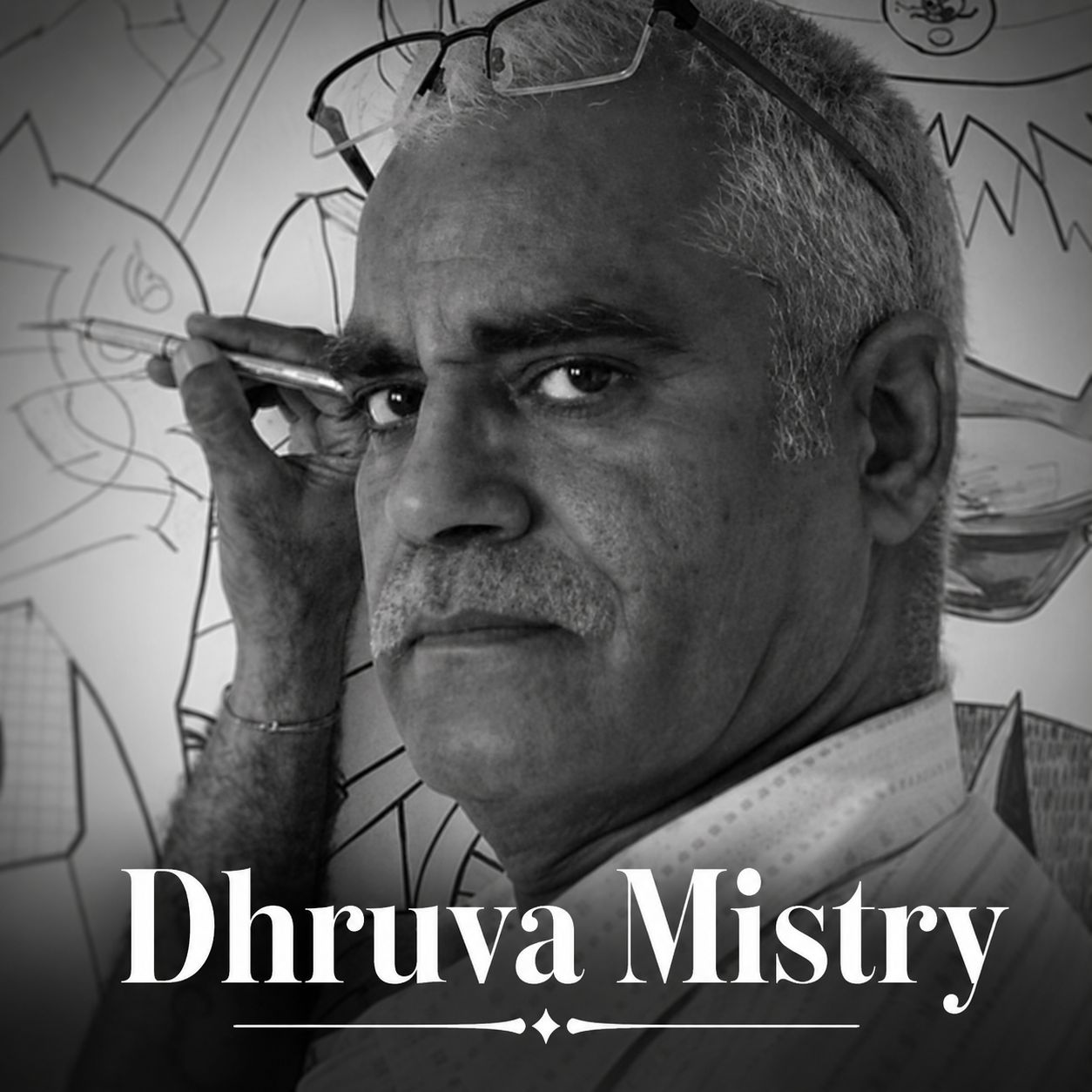
The Role of Cultural Identity in the Sculptures of Dhruva Mistry
Art practices in post-independence India presented a complex amalgamation of traditional and modernist visual aesthetics.
Many artists were looking at their cultural roots as inspiration for their artwork. In India, sculpting practices in particular have their roots dating back to the Indus Valley Civilization with small terracotta figurines depicting a range of wild and domesticated animals. As a result, sculpture became a powerful medium through which cultural identity could be expressed and preserved.
Among the artists who have successfully bridged traditional and modern sensibilities is Dhruva Mistry. Born in Gujarat, India, Mistry’s work is inspired by cultures from across the globe. Taking ideas from India, to Egypt and Greece, and from folk art, ancient and contemporary narratives, his work reflects the different experiences of the world around us.
This article examines how the renowned sculptor Dhruva Mistry skilfully integrates themes of cultural identity into his sculptures, producing works that resonate across time and tradition.
Also Read: The Enduring Relevance of Nalini Malani’s Art
Early Life and Artistic Formation
Born in Kanjari, Gujarat, in 1957, Dhruva Mistry studied at the Faculty of Fine Arts, The M S University of Baroda (1974 to 1981). During this formative period, he was exposed to both Indian artistic traditions and international modernist movements. Subsequently, Mistry was awarded a prestigious British Council Scholarship to study at the Royal College of Art in London from 1981 to 1983. This experience proved transformative, as it enabled him to engage directly with European artistic traditions
Mistry first came to wide attention with sculptures in painted plaster, frequently of hybrid human/animal forms.
His first solo exhibition was held at Art Heritage, New Delhi, touring to the Jehangir Art Gallery, Mumbai in 1982. He was Artist in Residence at Kettle’s Yard, with a Fellowship at Churchill College, Cambridge (1984-5), and since then he has regularly performed throughout the UK and internationally.
Living and working between India and Britain exposed him to multiple cultural perspectives, which would later become central themes in his sculptural practice.
Cultural Identity as a Central Theme
Dhruva Mistry’s sculptures explore cultural identity by fusing ancient Indian mythologies and folk art with classical Western and Modernist aesthetics. Rather than adhering to a single geographic or historical tradition, his works bridge East and West to address universal human experiences.
Drawing inspiration from ancient and modern civilizations, he uses a variety of materials and genres to explore cultural tension. The richness of Mistry’s imagery lies in his capacity to re-examine, re-interpret, and represent the most ancient symbols through a contemporary lens.
Key Themes
Key themes defining his work include:
- Hybridity & Mythical Guardians
Mistry frequently depicts ambiguous, hybrid creatures (like his Creature and Regarding Guardians series) that bridge the gap between human and animal. They serve as universal protectors, drawing equally on Egyptian sphinxes and Indian mythological figures like Yakshis.
- Liminality (The In-Between)
Rather than pinning his identity to one culture, Mistry places his sculptures in a “liminal” space—a transitional zone between abstraction and figuration, or ancient symbols presented through a modern lens.
- Cross-Cultural Synthesis
He seamlessly integrates Eastern and Western visual languages. For example, his monumental River in Birmingham uses the classical form of the reclining nude, while subtly evoking mythological figures.
- Temple Aesthetics
Breaking away from the monochromatic nature of Western marble or bronze, he often uses vibrant colours on plaster and fiberglass. This vivid use of colour is a direct nod to traditional Indian temple sculpture and folk art.
- Mass, Void & Geometric Abstraction
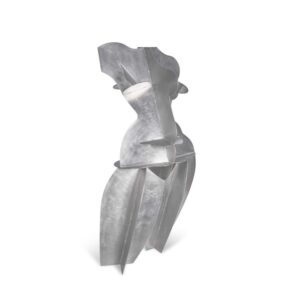
In his stainless steel and spatial works, Mistry reduces complex cultural icons to basic elemental shapes (squares, circles) utilizing laser-cutting to let light and air pass through.
Bridging Eastern and Western Traditions
One of the most remarkable aspects of Dhruva Mistry’s sculptures is the seamless integration of Eastern and Western artistic traditions. On one hand, the influence of European Modernism is evident through experimentation with form, abstraction, and scale. On the other hand, Indian traditions provide a wealth of symbolic, spiritual, and narrative references.
This fusion can largely be attributed to Mistry’s life between India, Britain, and the wider Western world. As a result, his sculptures often challenge the notion that artistic traditions must remain separate.
Key Sculpture
- The River and Youth (1991–1993)
These monumental bronze figures depict large, stylized representations of a reclining man and woman. Rooted in the visual tradition of the reclining nude, Mistry reimagines them with proportions that evoke ancient fertility deities and river goddesses, serving as cultural focal points in a Western metropolis.
Reinterpreting Ancient Symbols Through Contemporary Sculpture
A defining feature of Mistry’s work is his ability to re-examine ancient symbols through a contemporary lens. Traditional motifs are frequently incorporated into his sculptures, yet they are rarely presented in their original form. Consequently, viewers are invited to explore the continuing relevance of cultural traditions within a rapidly changing world.
Mythology and Folk Traditions as Cultural Markers
Indian mythology and folk art occupy a central position within Dhruva Mistry’s artistic practice. These traditions are frequently referenced not merely as aesthetic sources but as powerful markers of cultural identity.
Key Sculpture
- Creature series
Mistry frequently paints his plaster and fiberglass sculptures in vivid colours, drawing inspiration directly from Indian folk art and vibrant folk deities.
Hybridity and Mythical Guardians
Among the most distinctive themes in Mistry’s work is the concept of hybridity. Throughout his career, he has created numerous sculptures featuring ambiguous creatures that combine human and animal characteristics. These hybrid forms occupy a space between reality and mythology, thereby challenging conventional ideas about identity.
Furthermore, hybridity serves as a powerful metaphor for contemporary society. In an increasingly globalized world, identities are rarely defined by one culture alone.
Key Sculptures:
- Regarding Guardians of Art (1988–1989), National Museum Cardiff
Commissioned for the East Wing of the museum, this 3-meter-tall hybrid Portland Sandstone figure merges human and animal features. It draws on both Assyrian/Greek sphinxes and ancient Indian dwarapalas (door guardians).
- HanuMan: A Spatial Metaphor (2015–2019)
Inspired by the mythological epic of the monkey-god carrying the mountain to save Lakshmana, Mistry abstracts this classical lore into a geometric interplay of a monkey-like figure and a pyramid-mountain.
Public Sculpture and Global Cultural Dialogue
The significance of Dhruva Mistry’s work is further amplified through its presence in public spaces. Unlike sculptures confined to galleries, public artworks engage directly with communities and urban environments.
His monumental sculptures installed in cities such as Birmingham, London, and Tokyo create opportunities for cross-cultural dialogue.
Why Dhruva Mistry’s Exploration of Cultural Identity Remains Relevant
The exploration of cultural identity remains highly relevant in contemporary society. As globalization continues to reshape communities and cultures, questions regarding heritage, migration, and belonging have become increasingly important.
In this context, Dhruva Mistry’s sculptures offer valuable insights. Rather than presenting identity as fixed or exclusive, his work celebrates complexity, hybridity, and cultural exchange.
Final Thoughts
The role of cultural identity in the sculptures of Dhruva Mistry is both profound and multifaceted. Drawing inspiration from Indian mythology, folk traditions, ancient civilizations, and Western artistic movements, he has developed a sculptural language that transcends conventional boundaries.
By bringing together diverse influences and universal themes, he has created a body of work that continues to resonate with audiences worldwide.
Giftex Modern Indian Art Auction
This June, Giftex returns with its celebrated Modern Indian Art Auction. From iconic masterpieces to remarkable sculptures, discover works that embody artistic legacy, cultural richness, and timeless creativity.


About Post Author