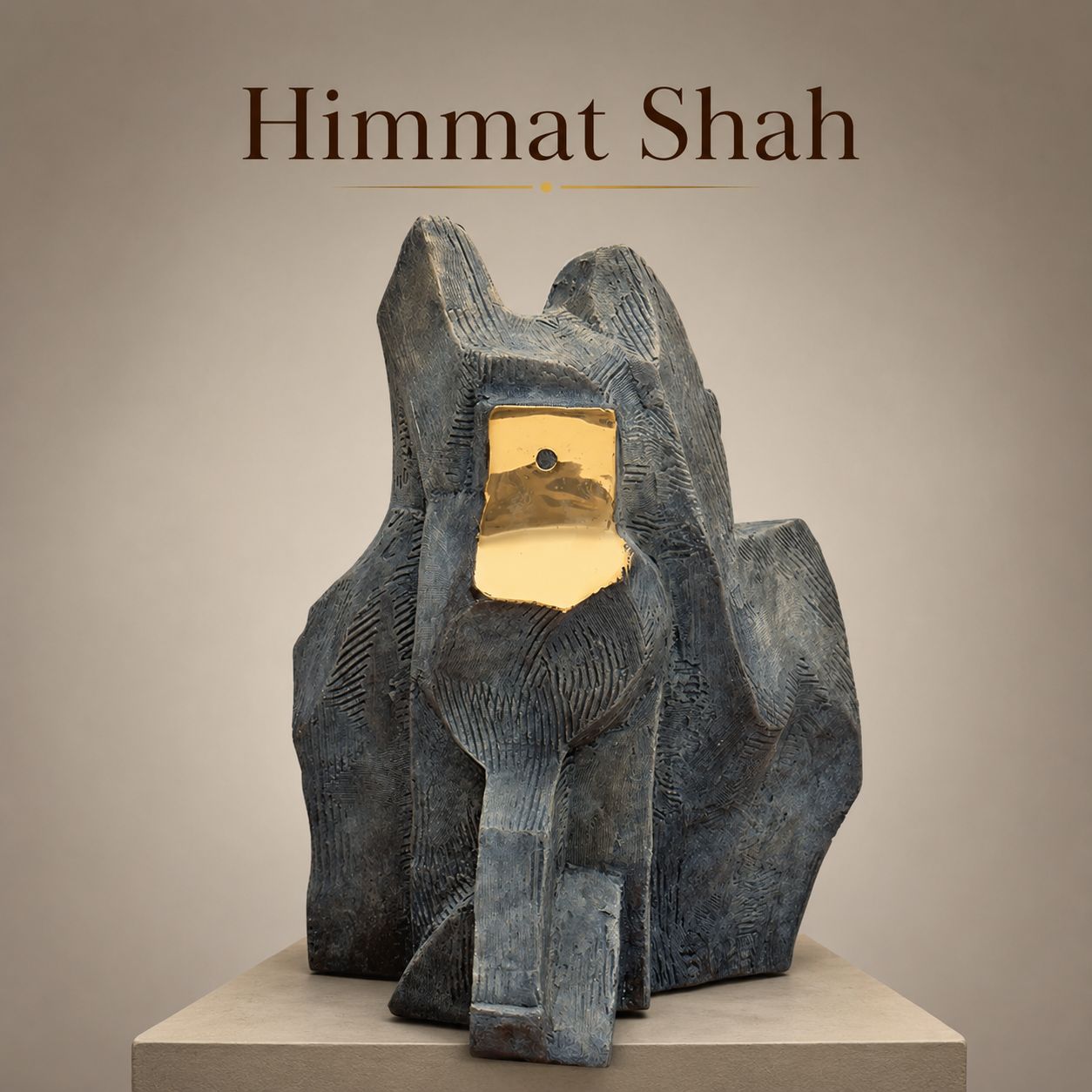
The Technical Rigor of Himmat Shah’s Slip-Casting & Kiln Experiments
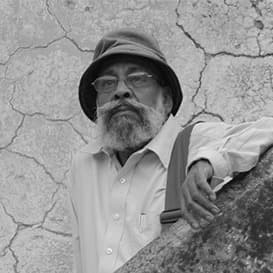
Himmat Shah
Among the pioneers of modern Indian sculpture, Himmat Shah occupies a distinctive position. Renowned for his experimentation with materials and form, Himmat Shah’s studio in Jaipur was a laboratory where he would use disparate tools, found objects, and mitti (clay), which he personally ground by hand and soaked in water for years to create art. Clay was not merely shaped but investigated. Kilns were not simply used for firing; they became sites of discovery where form, texture, and surface transformed. His self-designed tools and innovative techniques give his preferred medium, terracotta, a contemporary edge.
Through years of experimentation, Shah developed his own approaches to slip-casting, firing, and surface treatment, enabling him to create sculptures that appear simultaneously ancient and modern. This technical rigour played a crucial role in establishing his artistic language and contributed significantly to the enduring power of his work.
Early Life
Born in Lothal, Gujarat, in 1933, to a family of Jain traders and farmers, Shah grew up in the dry, flatlands surrounding the historic Indus Valley archaeological site.
As a child, Shah displayed a fiercely independent spirit and often resisted conventional schooling. Instead, his curiosity was drawn to the alchemical experiments conducted by his grandfather, who studied the medicinal properties of poisons, minerals, and natural substances. These early encounters with transformation, materiality, and experimentation would leave a lasting imprint on his artistic practice.
He moved to Bhavnagar as a young boy and studied at Gharshala, a school affiliated to Dakshinamurty, the intellectual and cultural centre of the nationalist renaissance in Gujarat.
At Gharshala, Himmat Shah studied under Jagubhai Shah, imbibing Gandhian values of economy and simplicity, which were to lie at the core of his practice.
He then joined the JJ School of Art in Bombay, and then moved on to Baroda on a government cultural scholarship from 1956 to 1960.
As a young artist at Baroda, Himmat Shah learnt avidly from N.S. Bendre, in whom he saw the image of a modern artist, and from K.G. Subramanyan.
His propensity for drawing was both natural and necessary. Himmat Shah was a member of Group 1890, a short-lived artists’ collective founded by J. Swaminathan.
Himmat Shah then received a French Government scholarship and went on to study etching at Atelier 17 under SW Hayeter and Krishna Reddy in Paris in 1967.
The experience expanded his understanding of surface, texture, and process. Significantly, the tactile and textural effects he encountered in printmaking would later find expression in his sculptural work.
The Foundation: An Intimate Relationship with Clay
Before discussing slip-casting and kiln practices, it is essential to understand Shah’s relationship with clay itself. Unlike many sculptors who regarded clay merely as a preparatory material for bronze casting, Shah treated it as a primary medium worthy of prolonged study.
At an art studio at Garhi, he started experimenting with clays and slips to develop a unique vocabulary in terracotta.
Surface irregularities, cracks, and textures were not viewed as flaws. Instead, they were embraced as evidence of the material’s life and transformation.
The Process: The Alchemist’s Approach
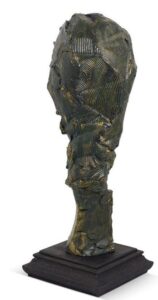
Himmat Shah Sculpture
Shah’s creative method went beyond traditional modelling, blending ancient artisanal techniques with radical, self-developed methodologies.
- The Mitti (Clay)
He often sourced earth from local potters’ colonies and prepared it meticulously. His practice involved grinding clay by hand and soaking it in water for extended periods. This process was undertaken to improve its workability and strength.
- Innovative Slip-Casting
One of Shah’s most remarkable technical achievements was the development of a personal slip-casting technique for terracotta and ceramic sculpture.
Because many of his delicate forms (such as those inspired by fragile glass bottles) could not be shaped on a potter’s wheel, he developed his own unique slip-casting technique.
- What is Slip-Casting?
Traditionally, slip-casting involves the pouring of liquid clay, known as slip, into porous plaster moulds. As moisture is absorbed by the mould, a solid clay layer forms against the interior surface. Once the desired thickness is achieved, excess slip is removed, and the cast object is allowed to dry before firing.
- Shah’s Methodology
Rather than creating identical copies, Shah created molds that were frequently manipulated, altered, and combined with hand-built elements. Everyday objects, bottles, funnels, and found forms were often transformed through the casting process into entirely new sculptural entities.
- Custom Tools
To carve, shape, and mold his works, he utilized an arsenal of non-conventional hand tools—including wood, iron, steel, and brass instruments, alongside toothbrushes and wire brushes.
- Kiln Experiments as Creative Research
Shah’s kiln experiments took a revolutionary approach to terracotta and ceramics, where the kiln served not just as a tool for baking clay, but as an active collaborator in his creative process.
- Manipulating the Fire
Shah observed nature closely—notably the changing forms and angles of a bird in flight—and applied these fluid concepts to the kiln. He intentionally angled the fires and manipulated temperatures to produce mysterious, accidental, and vibrant colours that he hadn’t planned.
- Material Preparation
His research involved rigorous preparation of the earth itself. He experimented with different local clays (such as those from potteries near railway stations), mixed them with organic additives like jute cloth and multani mitti (Fuller’s earth), and stored the clay in airtight containers for extended periods. This aging process resulted in a distinct smoothness and density, similar to ancient artefacts.
- Contrasting Mediums
As a part of his ongoing creative research, Shah would contrast the rough, baked earth from the kiln with luxurious metallic overcoats. He often covered his terracotta and ceramic works with silver or gold leaf, juxtaposing the raw, scorched heat of the kiln with the ageless, divine luster of precious metals.
- Surface Treatments and Material Transformation
The rigor of Shah’s experimentation extended beyond casting and firing. Surface treatments were also explored extensively.
Some early plaster heads were reportedly immersed in linseed oil to increase hardness before being covered with silver foil.
These treatments introduced additional layers of complexity. The sculptures acquired an aura of timelessness that reinforced their archaeological associations.
The Emergence of the Terracotta Heads
The most celebrated outcome of Shah’s technical experiments was undoubtedly his series of terracotta heads. Their creation required considerable technical precision. The elongated forms had to withstand drying and firing without collapsing or cracking excessively. At the same time, sufficient structural flexibility had to be retained to allow for expressive distortions.
Slip-casting proved particularly valuable in this context. The sculptures appeared as if they had been excavated from ancient archaeological sites precisely because the firing and surface treatments produced such evocative textures.
Final Thoughts
The enduring significance of Himmat Shah’s sculpture lies not only in its visual power but also in the extraordinary technical rigor that supported it. Through innovative slip-casting methods, prolonged engagement with clay, meticulous kiln experimentation, and sophisticated surface treatments, a distinctive sculptural language was developed.
Today, Shah’s sculptures continue to captivate audiences because they embody both technical mastery and conceptual depth. Their weathered surfaces, enigmatic forms, and timeless presence stand as evidence that innovation in art often emerges through sustained dialogue with materials.


About Post Author